

Are you watching decentralized forecasting explode and wondering how to launch your own Prediction Market Platform Like Polymarket?
I talk to entrepreneurs constantly. They know users want trustless spaces to trade on real-world events. But for anyone trying to build a Polymarket like Prediction marketplace platform from scratch, the math is brutal. Writing smart contracts and integrating oracle layers easily burns $250k and a whole year of development time.
That’s a timeline most startups simply can’t afford. It’s exactly why protocol architects now rely on a White label Polymarket solution. Deploying a White Label Prediction Market Platform Like Polymarket gets you secure, working code, meaning you go live in weeks instead of next year.
Here is the straightforward breakdown of how to launch your own White Label Prediction Marketplace Platform Like Polymarket without the technical nightmare.
What Is a White Label Prediction Market Platform?
Building a prediction market from scratch is a technical nightmare. I’ve watched too many founders burn six months just writing Solidity contracts and trying not to break their automated market makers.
That’s exactly why you use a white-label solution instead. You’re getting the liquidity pools, the resolution logic, and the blockchain infrastructure handed to you. Rather than building a backend from nothing, you just slap a custom UI on top of audited code and go live.
It bypasses the brutal costs of Custom prediction market platform development. You actually get to focus your energy on what matters: finding your niche. I’ve seen teams take this same codebase and build completely different platforms:
- Crypto: Markets for predicting layer-2 airdrops.
- Sports: Prop bets created entirely by the community.
- Politics: People are betting on the election swing states.
- Finance: Traders hedging against nasty inflation reports.
How Platforms Like Polymarket Work
I always tell founders that if you look under the hood, a decentralized prediction market isn’t just a glorified casino. It’s an aggressively efficient information machine. People put their actual cash on the line, which forces accuracy. Here is how that engine operates in reality, stripping away all the heavy Web3 jargon:
1. The Setup (Binary Outcomes)
Real life is complicated, but prediction markets force absolute clarity. They take chaotic, nuanced events and boil them down to a blunt Yes or No. I genuinely find this mechanic fascinating. Instead of vaguely debating ‘what happens to the economy,’ they ask a brutal, quantifiable question: Will the Fed cut interest rates in May? The contract then mints ‘Yes’ and ‘No’ shares specifically for that exact outcome.
2. The Odds (Pricing & Probability)
This is where the real magic happens. Every winning share always pays out exactly $1.00. Because that payout is hardcoded, whatever price the share is trading at right now acts as the crowd’s exact probability. If a ‘Yes’ share trades at $0.65, the market has collectively decided there is a 65% chance the event happens. It’s crowdsourced truth in real time.
3. The Trading Engine (Liquidity & AMMs)
You probably know how frustrating it is to trade on an illiquid exchange where you sit around waiting for another human to take the other side of your bet. Automated Market Makers (AMMs) fix that entirely. They act as an algorithmic counterparty that is always available. You want to buy it ? It sells to you, instantly tweaking the overall share prices mathematically based on supply and demand.
4. The Referees (Oracle Systems)
Here is the biggest technical headache we run into: blockchains are completely blind. A smart contract cannot watch the news to see who won an election, nor can it refresh a sports scoreboard. To figure out who actually won, the platform relies on decentralized oracles, usually systems like UMA or Chainlink. These networks agree on the real-world truth and lock that data securely onto the blockchain, where it can’t be tampered with.
5. The Payout (Smart Contracts)
This might be the best feature of the entire model. The literal second the oracle confirms the final result, the code takes over. No shady bookies are restricting your account, and there is no human reviewing your withdrawal request. The smart contract simply triggers and drops the funds straight into the winners’ wallets instantly.
Key Features of a Polymarket-Like White Label Platform
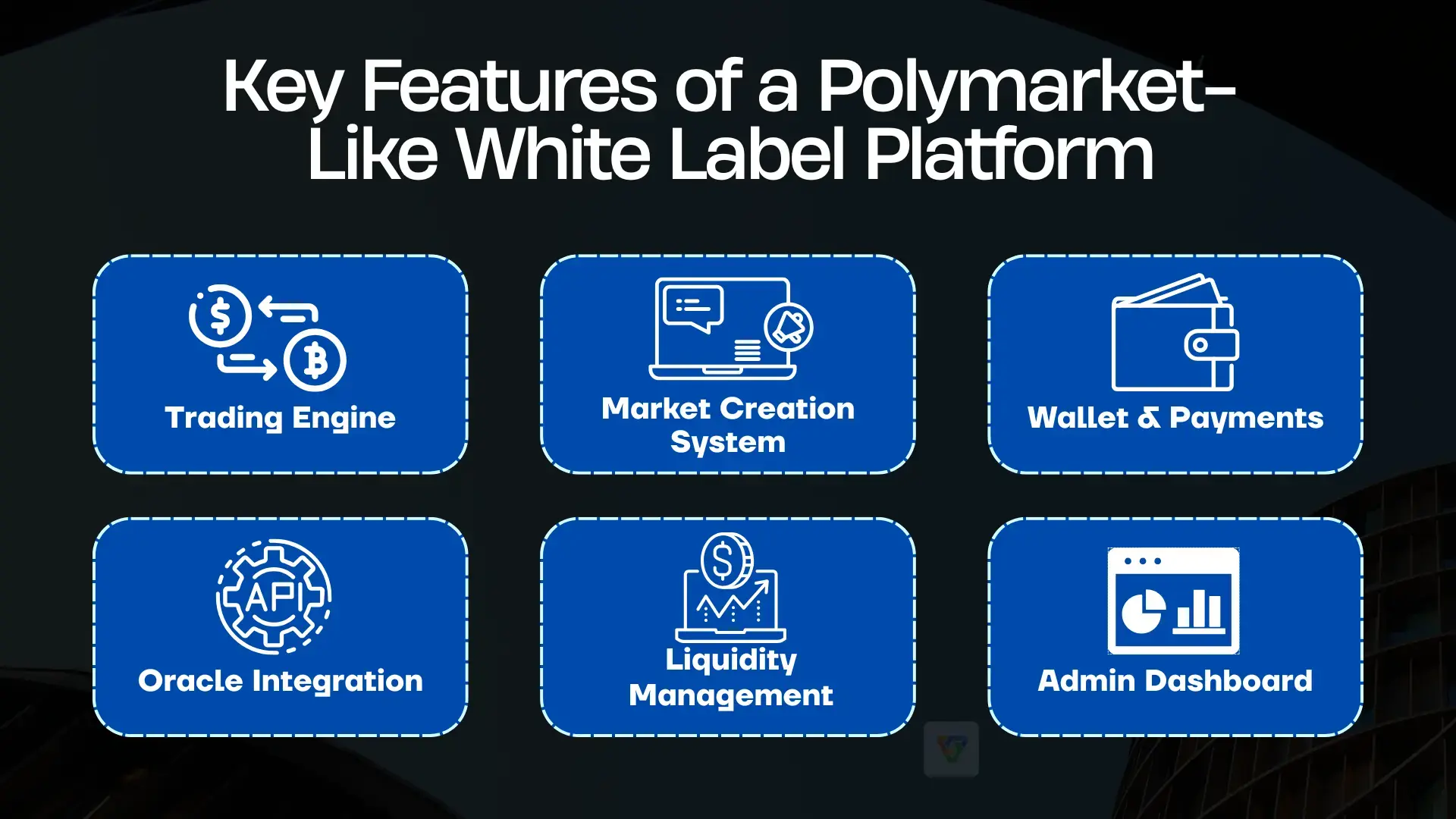
I tell every founder the same thing: launching a Polymarket like prediction marketplace platform is 10% frontend and 90% plumbing. If you are buying a White label Polymarket solution, verify that it comes with these mechanics already built. Otherwise, you’re just paying for a pretty UI.
Trading Engine
Nobody wants to stare at a slow order book, hoping a buyer eventually shows up. A Prediction Market Platform Like Polymarket needs Automated Market Makers (AMMs) so users can instantly trade against algorithmic liquidity pools.
Market Creation System
You absolutely need the ability to toggle how markets are made. A real White Label Prediction Market Platform, like Polymarket, lets you lock it down to Admin-Only for curated events, or open the floodgates to User-Generated pools when the community wants to bet on niche topics.
Wallet & Payments
Crypto onboarding is usually a nightmare, so yours can’t be. You need direct, frictionless hookups for MetaMask and WalletConnect, plus native support for USDC, since that’s the only stablecoin bettors actually want to use.
Oracle Integration
If the data feed is corrupted, your White Label Prediction Marketplace Platform Like Polymarket, is permanently ruined. You need tight integration with decentralized oracles (like UMA or Chainlink) to pull real-world data and settle bets without any human tampering.
Liquidity Management
A market essentially doesn’t exist if it has no liquidity. You need built-in yield incentives to convince Liquidity Providers (LPs) that dropping their capital into your pools is actually worth the risk.
Admin Dashboard
Even a decentralized platform needs a control room. You need a dedicated admin panel to aggressively tweak fees, step in on disputes, and enforce emergency risk controls when things get messy.
Types of White Label Solutions
You aren’t forced into a rigid, one-size-fits-all architecture. The best approach is a Custom White Label (Hybrid Model), giving you full ownership of the source code, total customization rights, and the flexibility to choose your backend setup:
- For Crypto Natives: You deploy a strict White label decentralized prediction market platform, where every trade and settlement happens trustlessly on-chain.
- For Traditional Bettors: Since realistically, many users hate gas fees and seed phrases, you can launch a White label centralized prediction market platform.
Both leverage the same powerful betting engine. The Hybrid approach just lets you choose whether you custody the funds centrally for ease of use, or leave it entirely on-chain for maximum transparency.
Technology Stack Overview
When you examine the underlying tech stack, a premium white-label platform is specifically engineered to handle massive consumer betting volume without breaking a single sweat. The core backend architecture typically anchors to a highly scalable, low-fee blockchain, like Polygon or an Ethereum layer-two. From there, it uses heavily audited smart contracts to securely manage the automated betting logic and permanently lock up your vital liquidity pools.
But a strong blockchain backend is entirely useless without a flawless user experience. On the user-facing side, you get a highly responsive React frontend wired up with Web3 integrations, ensuring your users’ crypto wallets connect instantly with zero friction. Behind the scenes, a lightweight Node.js architecture quickly handles the APIs and data indexing, while an immutable Oracle layer continually fetches verified real-world results. Finally, the entire system is wrapped in enterprise-grade security, so you never have to lose sleep over hackers draining your platform.
White Label Prediction Like Polymarket: Step-by-Step Launch Process
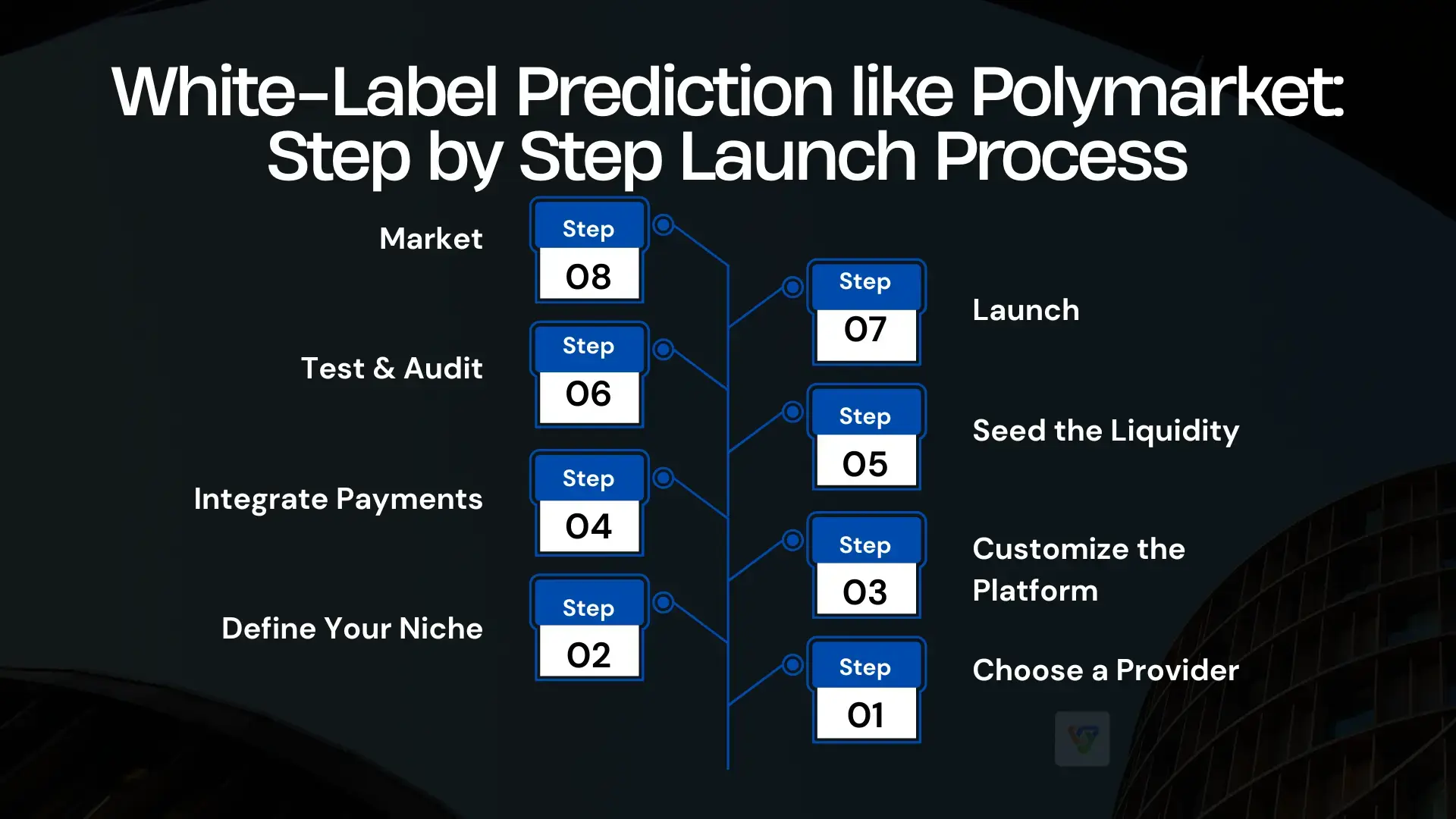
Step 1: Define Your Niche
Pick a specific audience to dominate first, whether that’s crypto traders, traditional sports bettors, or local politics.
Step 2: Choose a Provider
Don’t take their marketing at face value; demand on-chain credibility. Require the vendor to provide hard on-chain proof of past deployments and third-party audit reports before signing anything.
Step 3: Customize the Platform
Apply your own distinct branding and UX to the backend engine, so your platform doesn’t look like a lower copy-paste clone.
Step 4: Integrate Payments
Give users a frictionless onboarding experience by connecting both Web3 crypto wallets and standard credit card fiat on-ramps.
Step 5: Seed the Liquidity
You must solve the “cold start problem.” Empty markets die fast, so bootstrap your platform by funding initial Liquidity Provider (LP) incentives to get that crucial early volume churning.
Step 6: Test & Audit
This is absolutely non-negotiable. I have watched too many “Burned Crypto Builders” fail because they skipped a final smart contract audit to save a few days of development time.
Step 7: Launch & Market
Roll out your platform with a coordinated release, ensuring stability, liquidity readiness, and a seamless user onboarding experience.
Step 8: Market
Build early hype through social channels, influencer partnerships, and referral programs to rapidly grow and engage your community.
Revenue Models
A massive benefit of deploying a White label Polymarket solution is that the optimal monetization paths are already hardcoded directly into the backend. Here is exactly how a Prediction Market Platform Like Polymarket actually generates cash:
Trading Fees
You take a tiny fraction of a percentage on every single trade. Because Automated Market Makers process such high-volume, continuous trading, these micro-fees compound rapidly.
Market Creation Fees
If you eventually open your platform up to user-generated events, you can charge a flat stablecoin fee for anyone wanting to spin up their own specific betting pool.
Premium Analytics
Serious bettors are obsessed with data. You can gate advanced pricing charts, historical odds, and real-time oracle analytics behind a monthly premium subscription tier.
Token-Based Incentives
If you choose to launch a native platform token, you can deeply integrate it into your White Label Prediction Market Platform Like Polymarket. By allowing users to pay trading fees at a discount using your token, you create massive, organic demand for it.
Legal & Compliance Considerations
Here is something most vendors won’t tell you upfront: the legal landscape around prediction markets is genuinely messy. Many regulators don’t care whether you call it “forecasting” or “trading”; if money changes hands on an outcome, they will find a reason to classify it as gambling. That’s why most serious founders don’t fight the system. They geo-block US and EU users from day one and set up their company in a crypto-friendly jurisdiction where there isn’t a regulator breathing down their neck.
The moment your platform touches fiat money or holds user funds, KYC and AML checks become unavoidable. Going fully decentralized sidesteps a lot of that friction since you’re only dealing with anonymous wallets, but honestly, that grey area has its own risks too. Regulated competitors like Kalshi have burned years and millions getting government approvals. You won’t beat them there. What you can beat them on is speed to market, global access, and a crypto-native experience they simply cannot offer.
Future Trends in Prediction Markets
The prediction market space is evolving fast. Here is where things are heading in the future,
AI-Driven Markets: AI agents are already autonomously creating and trading in markets. Soon, they will act as permanent market makers, keeping liquidity flowing without any human involvement.
DeFi Integration: Prediction markets are merging with DeFi. Your LP position could soon double as loan collateral, and your winnings could auto-route into yield strategies the moment a market settles.
Social & Gamified Platforms: The fastest growing platforms will feel like games, not trading desks. Leaderboards, streaks, and social feeds showing what your friends are betting on will drive the next wave of users.
Institutional Adoption: Hedge funds are already monitoring these markets for price-discovery signals. Once regulations catch up, institutional money will follow quickly.
Conclusion
The demand for decentralized prediction markets is proven and growing. The window to grab a strong position in this space is open right now. Building from scratch is the slow, expensive path. Deploying a White label Polymarket solution gets you directly to market with audited smart contracts, an AMM engine, and oracle infrastructure already in place. A solid White Label Prediction Market Platform Like Polymarket, means you compete on strategy, not on debugging code.
That said, technology alone won’t guarantee success. Teams that win with their White Label Prediction Marketplace Platform Like Polymarket, focus on two things that truly matter: seeding enough early liquidity for markets to actually function, and picking a niche sharp enough that their Polymarket like Prediction marketplace platform becomes the first place a specific community goes. Get those two right, and you have a genuinely solid business.
White label Polymarket solution, White Label Prediction Market Platform Like Polymarket, White Label Prediction Marketplace Platform Like Polymarket, Prediction Market Platform Like Polymarket, Polymarket like Prediction marketplace platform.
FAQs for the White Label Prediction Market Platform
A platform where users trade shares on real-world event outcomes. A Prediction Market Platform Like Polymarket uses smart contracts to automate payouts.
It depends entirely on your jurisdiction. Most founders geo-block strict regions and incorporate in crypto-friendly countries to stay compliant from day one.
Building from scratch costs $250k+. A White label Polymarket solution cuts that drastically, letting you launch for a fraction of the original cost.
Through trading fees, market creation fees, premium analytics, and token incentives built into your White Label Prediction Market Platform Like Polymarket.
From scratch, 12+ months. A White Label Prediction Marketplace Platform Like Polymarket gets your Polymarket like Prediction marketplace platform live in 4–8 weeks.