When BlackRock moved $500 million onto the blockchain through its BUIDL fund, the financial world took notice, not because it was surprising, but because it meant something had shifted for good. RWA tokenization was no longer a conference talking point. It was a business decision made by the world’s largest asset manager. The conversation around real world asset tokenization spent years stuck in pilot programs and cautious optimism. That phase is done. Asset tokenization is now being built into financial infrastructure, the same way digital payments were twenty years ago, quietly, then suddenly everywhere. The market has stopped asking “Will this work?” The real question now is who actually builds the RWA Tokenization development company. That is what this guide is about: why 2026 matters, who is positioned to lead, and what it takes to launch an RWA tokenization platform with staying power.
What Is RWA Tokenization And Why Should You Care?
RWA tokenization is the process of converting ownership of real-world assets, property, government bonds, commodities, and private credit into digital tokens on a blockchain.
Instead of holding a paper deed to a property or a certificate for a bond, you hold a programmable token representing the same ownership. It can be traded at any time, split into fractions, and verified on-chain without calling a broker or waiting for a settlement window.
That is really what changes here. Not the asset itself. The way ownership of it moves.
Why should you care:
There are roughly $500 trillion in global assets, real estate, equities, fixed income, commodities, and most of it is illiquid, gated behind high minimum thresholds, and processed through intermediaries that eat into returns. Asset tokenization cuts through most of that.
- For investors, it opens asset classes that were effectively off-limits.
- For asset owners, it creates exit options that did not exist before.
- For builders, it is a large market with very few established players.
The gap between what exists on-chain today and the total value of global assets is not a small inefficiency. It is the whole opportunity.
Why 2026 Is the Best Time to Start an RWA Platform
The early mover window is still open, but it is closing faster than most people realize. Here is why 2026 specifically is the inflection point for anyone looking to build an RWA tokenization platform:
Reason 1: Institutional demand is surging, with not enough platforms to serve it. BlackRock, Franklin Templeton, JPMorgan, and UBS are all on-chain. Their institutional clients want exposure to tokenized instruments. The demand exists, but the platforms to route it through remain scarce.
Reason 2: Regulatory frameworks are finally in place. MiCA in the EU, MAS licensing in Singapore, VARA and DIFC in the UAE, and growing SEC clarity in the United States have collectively provided the legal foundation that was missing in every previous cycle.
Reason 3: DeFi protocols are actively hunting for real-world yield sources. Aave, MakerDAO, and Compound are integrating real world asset tokenization products as collateral. The DeFi infrastructure is actively pulling RWA supply in.
Reason 4: The technology stack is now mature. Oracle networks, token standards such as ERC-3643 and ERC-1400, institutional custody solutions, and on-chain compliance rails are all production-ready in 2026 in a way they simply were not two years ago.
Reason 5: Retail investors are hungry for fractional, yield-bearing alternatives. The next generation of investors wants globally accessible, income-generating assets. Tokenization of real world assets delivers fractional entry, automated yield, and 24/7 liquidity in one instrument.
The platforms being built today will capture the liquidity, the brand recognition, and the network effects. Every month of delay is market share handed to a competitor who started sooner.
What Kind of RWA Platform Can You Start?
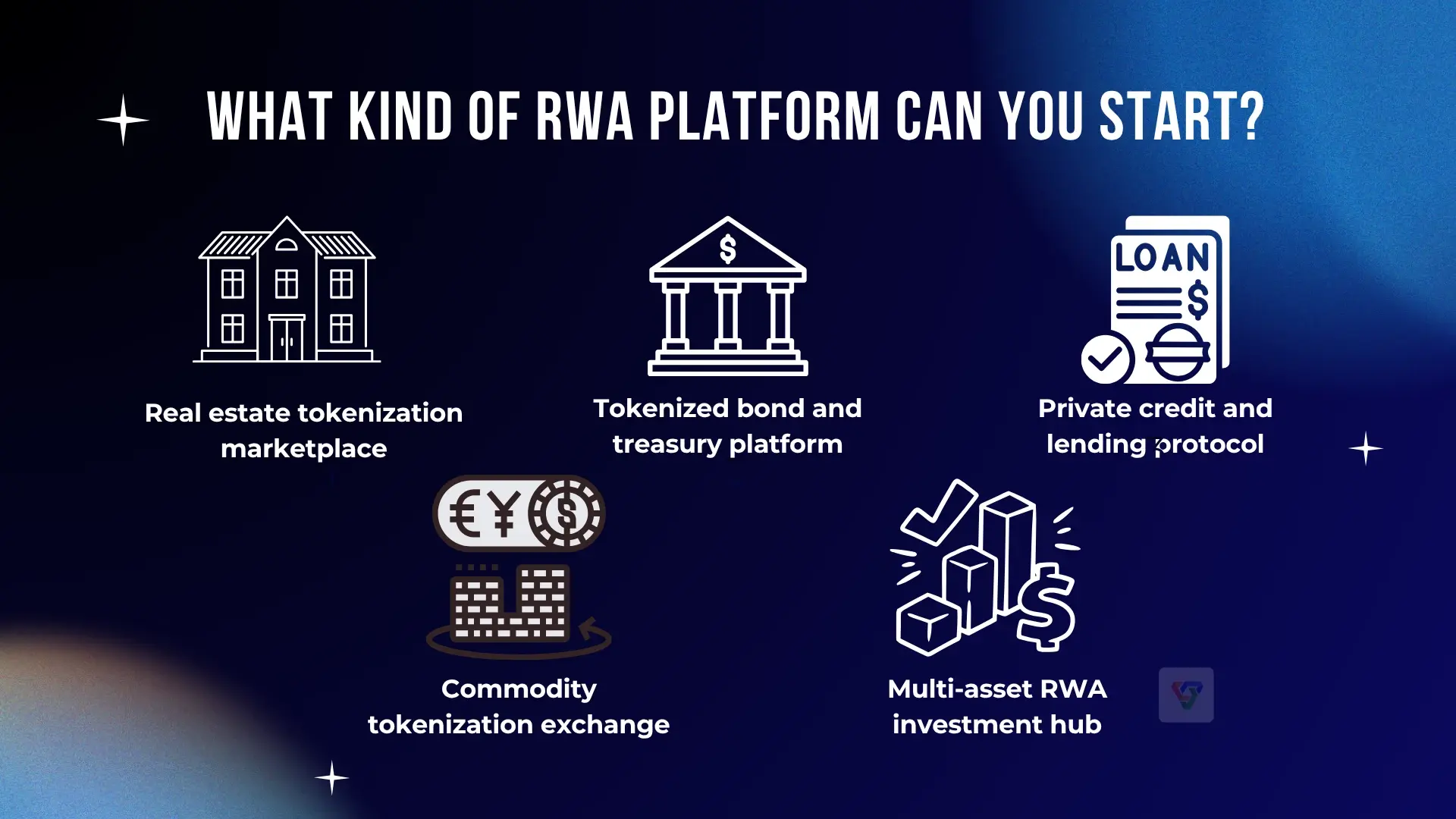
The first real decision a founder has to make is which niche to go after. It is not just about what sounds interesting. The platform you build needs to fit your regulatory situation, your market knowledge, and where actual investor demand exists in your region. Five platform types are seeing serious traction in 2026:
Real estate tokenization marketplace
Fractional ownership of commercial and residential property. Real estate tokenization reaches the widest retail audience and is the easiest concept for everyday investors to grasp without explanation.
Tokenized bond and treasury platform
Government securities and corporate debt on-chain. Ondo Finance and Franklin Templeton have already proven this model works at scale.
Private credit and lending protocol
Connecting institutional lenders to verified on-chain borrowers. The yield is high, the competition is thin, and the demand from both sides keeps growing.
Commodity tokenization exchange
Gold, silver, oil, carbon credits. Asset backed tokenization tied to physical collateral is among the easier models to run from a regulatory standpoint.
Multi-asset RWA investment hub
Although one platform covering multiple asset classes for investors who prefer not to use five different tools.
The niche you pick will shape your legal structure, your operational model, and your positioning. It is worth getting right before anything else.
The Business Opportunity, Market Size & Revenue Potential
BCG and McKinsey both projected that the global tokenization of real world assets market will hit $10 trillion by 2030. Given the pace of institutional inflows and regulatory adoption since those reports were published, that number may already be undershooting reality. The revenue model for platform operators is straightforward and well-tested:
Asset management and AUM-based fees
A percentage of assets under management, charged annually as the portfolio grows.
Issuance and listing fees
Paid by asset originators and fund managers when they bring assets onto the platform.
Secondary market trading fees
Earned on every token transfer or peer-to-peer trade that runs through your system.
Premium analytics subscriptions
Institutional-grade reporting and dashboards are sold as a recurring subscription to serious investors.
Yield spread capture
The platform retains a basis point spread between the gross yield of the underlying asset and what gets distributed to token holders.
These are the same fee structures that fund administrators and exchanges have run for decades. The difference is that the overhead is lower and the investor base is global from day one.
Legal Structure: The Foundation You Cannot Skip
Most RWA tokenization development projects that stall early share the same problem: the legal work was left for later. By the time the founders circled back to it, the architecture was already built on assumptions that did not hold up in court.
SPV Setup: A Special Purpose Vehicle separates the underlying real-world asset from the operating company. It limits liability, protects investor claims, and creates the legal wrapper that gives tokens genuine ownership standing. Most institutional-grade platforms are built on this structure from day one.
Jurisdiction Selection
🇺🇸 USA: Regulation D and Regulation S cover private placements to accredited and non-US investors. Well-understood but compliance-heavy.
🇸🇬 Singapore: MAS Capital Markets Services licensing gives operators a credible, stable framework that institutional investors recognize and trust.
🇦🇪 UAE: VARA and DIFC have built one of the more practical regulatory environments for tokenized asset platforms in 2026.
🇪🇺 Europe: MiCA provides a unified legal framework for cross-border digital asset tokenization for the first time across 27 member states.
Token Classification: Are you issuing a security or a utility token? For real estate tokenization platforms and bond issuances, it is almost always a security. That means licensing, investor eligibility controls, and transfer restrictions written directly into the token contract, before launch, not after.
KYC/AML at Scale: Use an established identity verification provider, Sumsub, Onfido, or Jumio, to handle onboarding automatically. It keeps you compliant across markets without building the infrastructure yourself.
Technology Stack What Powers an RWA Platform
In contrast, the technology choices made at the architecture stage determine how scalable, secure, and compliant your RWA tokenization platform can ultimately become.
Blockchain Layer: Ethereum remains the institutional trust anchor; Polygon for cost-efficient transactions; Stellar for cross-border payment optimization; Avalanche for private institutional subnets
Token Standards: ERC-1400 for semi-fungible securities with transfer restrictions; ERC-3643 (T-REX protocol) for compliance embedded directly into the token layer, the standard used by leading asset tokenization development company teams globally
Smart Contracts: Solidity with Hardhat and OpenZeppelin is the production standard for any real estate tokenization platform or multi-asset RWA system
Oracle Layer: Chainlink for price feeds and settlement triggers; Pyth Network for high-frequency NAV updates for institutional products.
Security infrastructure: Multi-signature wallets, role-based access control, on-chain audit logs, and required third-party smart contract audits before any asset goes live.
Cross-Chain Interoperability: LayerZero and Axelar to bridge tokenized assets across networks, important for reaching institutional liquidity pools on several chains.
Build vs. White Label — Which Path Is Right for You?
Based on the table below, you can decide which one is better for your business. Come on, lets we go:
| Factor | Build from scratch | White label solution |
| Time to market | 12-18 months | 8-12 weeks |
| Cost | Very high | moderate |
| Customization | Full | Partial to full |
| Compliance ready | You build it | Often pre-built |
| Audit history | Zero to launch | Proven and tested |
| Best for | Large funded teams | Startups and fast movers |
For most founders embarking on asset tokenization platform development, the white label method provides the quickest path to a live, audited, compliant product – with customization choices that increase as the company expands.
The build-from-scratch strategy is only appropriate when a team has extensive technical resources, substantial funds, and a proprietary architecture requirement that no existing solution can meet.
How to launch your RWA platform
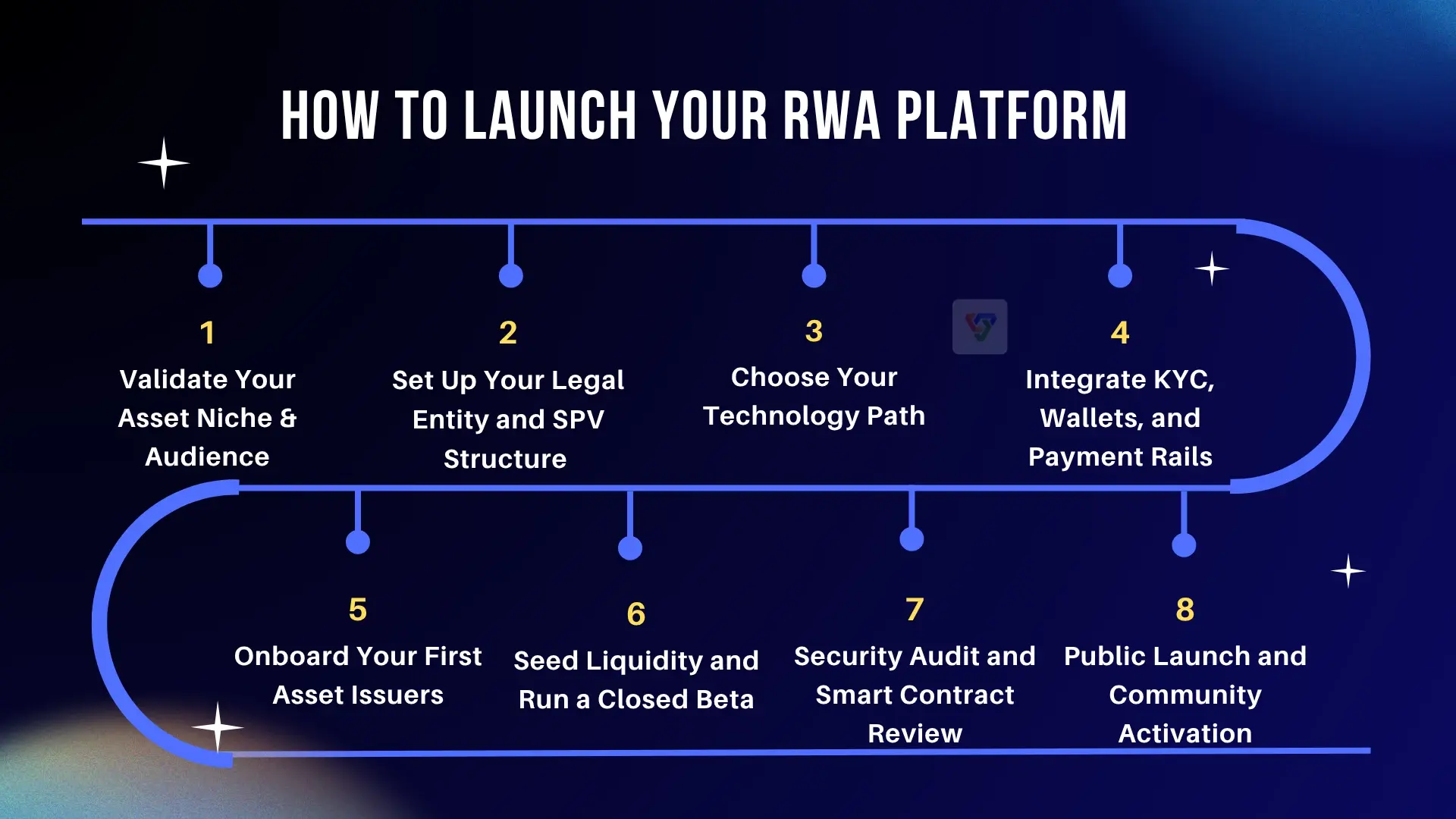
Are you eargely waiting for the Yeah! Below are the steps for launching the RWA tokenization platform development
Step 1: Validate Your Asset Niche & Audience
In 2026, real estate tokenization and tokenized treasury products are where investor demand is most visible and easiest to validate.
Step 2: Set Up Your Legal Entity and SPV Structure
Talk to a lawyer who specializes in RWA Tokenization development securities before you touch the technology. The legal structure decides what you can build, who you can serve, and which jurisdiction makes the most sense for your market.
Step 3: Choose Your Technology Path (Build or White Label)
When evaluating vendors, look at their blockchain support, how complete their compliance module is, their audit track record, and how much you can actually customize. Do not choose based on pitch decks alone.
Step 4: Integrate KYC, Wallets, and Payment Rails
Onboarding is the first thing investors experience. If it is slow or confusing, they drop off before they ever fund an account. Get this right early.
Step 5: Onboard Your First Asset Issuers
Before you open to the public, bring in two or three issuers with solid, credible assets behind them. Your first listings set the quality standard for everything that follows.
Step 6: Seed Liquidity and Run a Closed Beta
Get a small group of accredited investors in early, build some liquidity, and watch how real users move through the platform. Fix what breaks before it breaks publicly.
Step 7: Security Audit and Smart Contract Review
Do not launch without a full third-party smart contract audit. CertiK, Quantstamp, and Hacken are the names institutional investors look for. Skipping this step is not a calculated risk; it is just a bad decision.
Step 8: Public Launch and Community Activation
Push across PR channels, list on rwa.xyz and DeFiLlama, publish on LinkedIn, and announce key partnerships with custodians and wallet providers on the same day. A scattered launch loses momentum fast.
The Future of RWA Tokenization — Where This Is Heading
However, the trajectory of real world asset tokenization is no longer a question of whether, only how fast:
AI-driven asset valuation and risk scoring: Machine learning models delivering real-time NAV calculations and risk assessments for tokenized portfolio positions, replacing slow and costly manual appraisal processes.
RWA + DeFi convergence: Tokenized real estate, treasury bills, and private credit becoming standard collateral in lending protocols, structured yield products, and on-chain derivatives. The integration between RWA tokenization and DeFi liquidity infrastructure will define the next market cycle.
CBDC integration: Central bank digital currencies settling tokenized asset transactions natively on-chain, enabling true T+0 settlement for institutional trades at a global scale.
Retail-first tokenization platforms: Mobile-first apps where any investor anywhere can allocate $10 into a tokenized Treasury bill, a fraction of commercial real estate, or a private credit instrument within a single regulated wallet experience.
The 2030 vision: A global financial system where every bankable asset class and every major institution operates on tokenized rails. Built the Rwa Tokenization marketplace platform development today that survives its first compliance cycle and builds genuine secondary market liquidity, becoming the infrastructure layer of that future.
Conclusion: The Market Is Ready, The Only Question Is Who Builds It
The Rwa Tokenization development company is not a hype. It is the same kind of structural shift the internet brought to how information moves, quiet at first, then suddenly foundational and everywhere.
The Rwa Tokenization marketplace platform development that will lead this market by 2030 is being built today. Founders who pick a clear niche, sort the legal structure early, and launch a real product in 2026 are positioned to lead when the market fully matures. The investor demand is proven. The regulation exists. The technology is ready. The only thing missing is who actually builds it.
FAQs – RWA Tokenization Platform
Start now to capture early demand; an rwa tokenization platform unlocks liquidity and global access with faster, compliant asset trading.
Real estate and private credit are the most straightforward; real estate tokenization development services facilitate onboarding and fractional ownership.
The cost of a scalable tokenization app or rwa tokenization platform varies depending on the features; budgets range from MVP to enterprise-level.
Yes, compliance is important; work with an asset tokenization business to ensure that your tokenization RWA operations fulfill all applicable requirements.
A white label solution from a proven asset tokenization platform development provider can deliver a compliant, audited MVP in 8–12 weeks versus 12–18 months for a custom build.
Choose Ethereum or Polygon; a strong RWA tokenization platform depends on scalability, cost, and security for tokenizing real world assets.

![The Truth About AI Powered Centralized Crypto Exchanges [Proven Results]](http://www.trioangle.com/blog/wp-content/uploads/2025/08/The-Truth-About-AI-Powered-Centralized-Crypto-Exchanges-440x247.webp)