
Are you planning to launch your Uber clone app in the USA? Then you are in the right place.
Sometimes, launching your own ride-hailing business is not an overwhelming task. With the right strategy, you can launch a powerful taxi booking app in the US and compete with the industry giants.
Read this blog till the end, as this guide breaks down the process and shows you how to create your own U.S.-based taxi app.
🚖First, get to know the Ride-hailing market of the USA
- By 2030, the US is expected to become one of the top countries driving earnings in the ride-hailing industry worldwide.
- Forecasts show that revenue from the U.S. ride-hailing sector may reach around $54.7 billion by 2025 and could climb to about $60.5 billion by 2029, indicating steady growth.
- The number of people using ride-hailing services across the United States is projected to approach 100 million users by 2029
- Each user in the U.S. ride-hailing space is predicted to contribute an average yearly revenue of roughly $590.
🔍So, why starting an Uber clone is the best option in the USA?
Texas
Rules for operating taxi or ride-hailing services differ from one Texas city to another. For example, Austin requires platforms to formally enroll with local authorities and demonstrate that appropriate insurance protections are in place.
Houston, on the other hand, focuses heavily on driver vetting and mandates that the service maintain uninterrupted insurance coverage throughout each trip.
California
The California Public Utilities Commission (CPUC) oversees and regulates digital taxi platforms, setting detailed standards related to insurance coverage, driver screening, and other operational requirements. Providers must also make sure their services can accommodate riders with disabilities.
Under Assembly Bill 5 (AB5), California places ride-hail drivers in the employee category rather than classifying them as contractors.
New York (NY)
New York City imposes its own set of rules on ride-hailing services. Platforms must follow the city’s guidelines on fare practices, obtain the necessary operating approvals, and ensure thorough vetting of drivers. The Taxi and Limousine Commission (TLC) also requires drivers to carry approved insurance, and the platform must display transparent pricing information to riders.
🚀Understanding Taxi App Requirements Across Different USA States
re thorough vetting of drivers. The Taxi and Limousine Commission (TLC) also requires drivers to carry approved insurance, and the platform must display transparent pricing information to riders.
🎯Step-by-step Guide to Build an Uber clone in the USA
Let’s see the step-by-step process involved in building your Uber clone in the USA.
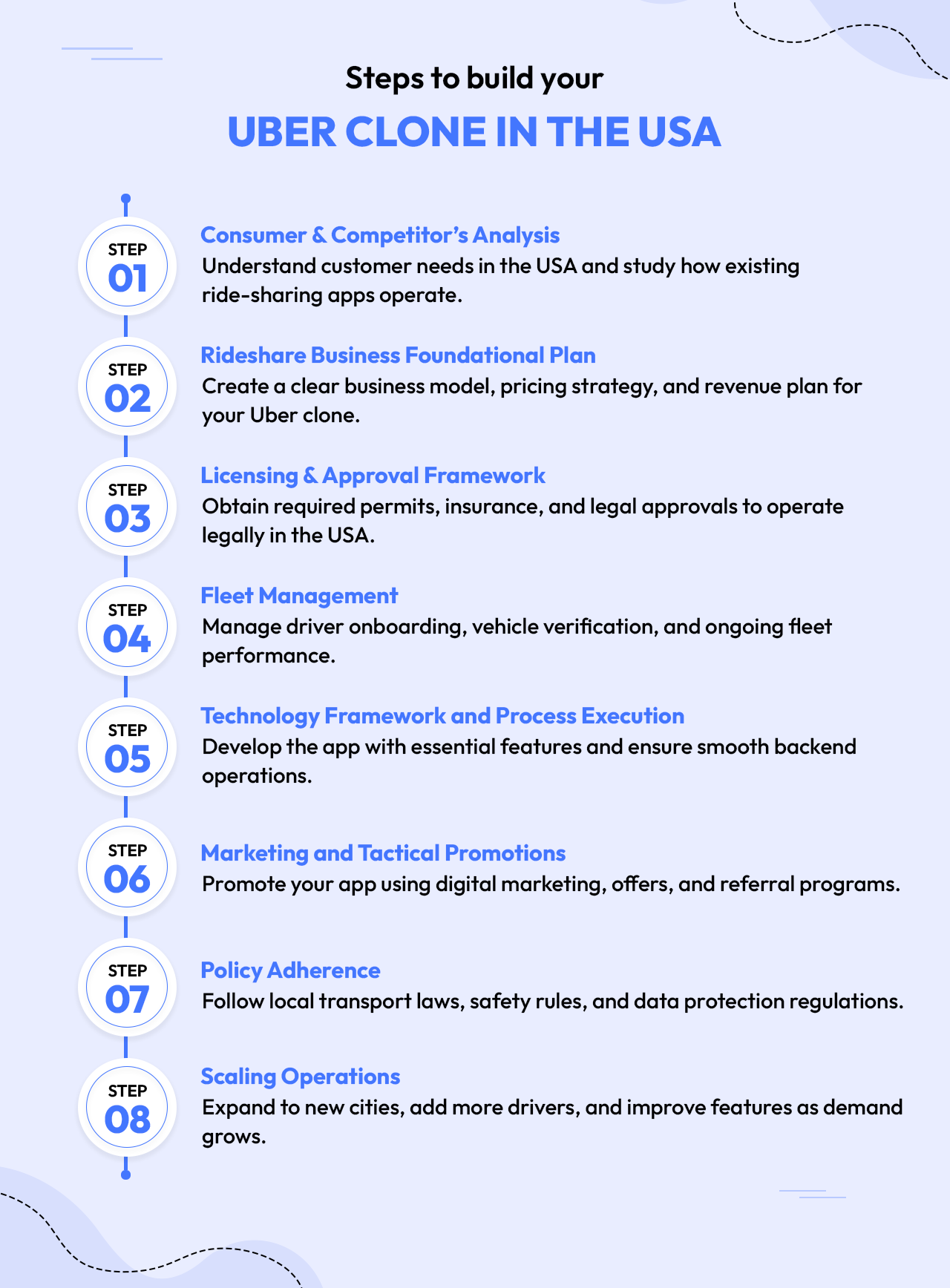
Step 1: Consumer & Competitor’s Analysis
Research your market perfectly to understand who you are serving and what your target audience is. Consider conducting surveys, analyzing trends, studying competitors, and gathering feedback to gain actionable insights that will help shape your strategy effectively.
Step 2: Rideshare business foundational plan
Develop a detailed business plan outlining your operational strategy, revenue projections, promotional tactics, and growth roadmap. This plan will serve as both a key tool for securing investors and a strategic blueprint to steer your company’s development.
Choose the appropriate legal entity for your business, such as a partnership, LLC, sole proprietorship, or corporation, keeping in mind that each option carries distinct implications for taxes, personal liability, and regulatory responsibilities.
Step 3: Licensing & Approval framework
Insurance policies: Different policies are needed to start a taxi app like Uber, as they help ensure compliance with state and local laws.
Federal and State Requirements: Regulatory obligations for Transportation Network Companies (TNC) differ across states and municipalities, so you’ll need to prepare for requirements such as thorough driver vetting, review of driving histories, routine vehicle inspections, and appropriate TNC-level or commercial insurance coverage.
Authorities also mandate zero-tolerance rules and robust safety tools within the app. In addition, you must follow relevant privacy and data protection laws, including CPRA in California and similar state statutes, along with TCPA guidelines for obtaining messaging consent and PCI DSS standards for processing payment information.
If your platform includes a digital wallet, ensure proper KYC procedures and ongoing monitoring of financial activity. Where applicable, provide wheelchair-accessible ride options and maintain a clear, publicly available policy on accessibility and nondiscrimination.
Step 4: Fleet Management
Determine whether you will lease vehicles or buy them outright, selecting models that fit your service niche and customer needs.
Alongside vehicle acquisition, put in place a thorough maintenance plan that includes routine inspections, safety assessments, and timely repairs to ensure consistent reliability and passenger protection.
Step 5: Technology Framework and Process Execution
Now, it’s time to build your Uber clone app using a robust tech stack. Using the tech-stack mentioned below, make your app efficient and functional.
- Mobile development: Kotlin for Android, Swift for iOS system
- Front-end: HTML, CSS, and React.js
- Back-end: PHP Laravel framework, Node.js, Python
- Database: MySQL for structured data
- Mapping and Third-party integration: Google Maps, MapBox are used for maps. For payment integration, PayPal, Stripe, and Braintree are used.
Time to check out the necessary features to add to your Uber clone script using the tech stack to make it strong and efficient for the Rider, the driver, and the Admin.
a) Rider Features
The top features to have in the rider app are listed below.
Uncomplicated login: Riders can log in to the app using their name, phone number, or email address. If not, they can log in using other social media platforms like Apple login or Facebook login.
Dynamic pricing Bid: Riders can place their own fare bids based on their budget and ride demand. This gives them more control over pricing and helps them find a suitable driver faster.
Real-time tracking of Drivers: Users can track the location of the drivers in their mobile app to know exactly where they are, thereby increasing the safety of the drivers.
Fare estimation: The app gives an approximate fare before booking the ride. Riders can check the cost in advance and make informed decisions.
Diverse payment options: Typically, users have various payment options to choose from to pay for the services. They can either use credit or debit card options, or they can prefer the COD option if that is their preference.
Customer Feedback: Users can add their reviews and ratings in the app. This makes it easier for the new customers to make better decisions in terms of picking drivers based on their ratings and other factors, too.
b) Driver Features
Let’s break down the essential features available for the driver.
Quick verification process: Drivers can sign up by uploading basic details and documents. The admin can verify them quickly to start driving.
Accept or reject rides: Drivers get requests from the riders; however, drivers can choose if they want to accept or reject the rides based on their schedules.
Trip History: Drivers can check out their previous trips, transaction history, and date & time in case they want to.
In-App chat system: Drivers can connect with the users if they want to clarify any doubts regarding the route or other possible queries without sharing their contact details.
Earning dashboard: They can view their daily, weekly, monthly, and yearly earnings with clear breakdowns.
c) Admin Features
Let’s get into the Admin features.
User profile console: The admin can manage all rider and driver profiles from one dashboard. It allows viewing details, updating information, and handling account issues easily.
Vehicle Tier choices: Admins can create and manage different vehicle categories like economy, premium, or SUV. This helps set pricing, availability, and rules for each tier.
Geo-fencing: The admin can define specific service areas on the map. This helps control where rides can be booked and prevents trips outside restricted zones.
Performance Insights: Admins get detailed analytics on trips, revenue, user activity, and driver performance. These insights help improve operations and make informed business decisions.
Step 6: Marketing and Tactical Promotions
Now that you have your Uber clone ready, it’s time to launch the product into the real world. For that, you need proper marketing strategies, so try to build a strong and attractive brand identity for your taxi business.
Then, to reach potential customers, prefer employing digital marketing tactics, which include online ads, social media marketing, and many more.
Step 7: Policy Adherence
Stay informed about any changes in transportation regulations, as failing to follow updated requirements can lead to penalties and potentially jeopardize your operating permits.
Step 8: Scaling Operations
As demand grows, you can scale your fleet by adding more vehicles and introducing new categories to serve a wider range of customers.
Once your operations are running steadily, consider moving into nearby cities or additional regions to extend your reach.
To accelerate this expansion without heavy upfront investment, you can also explore franchising as a strategic way to enter new markets while sharing operational responsibilities with local partners.
💰How much does it cost to develop a Uber clone in the USA?
Depending on various factors, the cost to build your Uber clone in the USA fluctuates.
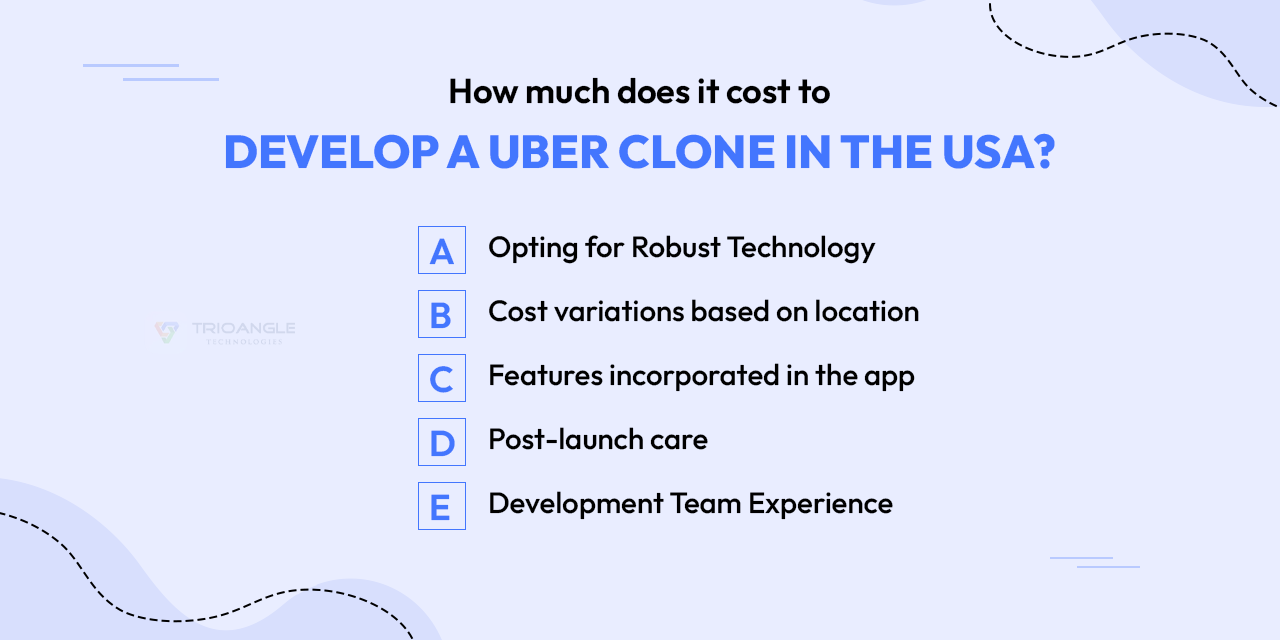
Opting for Robust Technology
Choosing a strong tech-stack is important to make your Uber-like app work smoothly. Good tech ensures that your app runs fast and handles many users effortlessly to stay secure. It also helps crash and improves the overall performance of the app.
Cost variations based on location
The total cost to build an Uber clone can change depending on where your development team is located. Developers in regions like the US or Europe usually charge more, while teams in Asia or Eastern Europe may offer lower rates. Location directly affects the overall project budget.
Features incorporated in the app
The final cost and complexity of your Uber clone depend on the features you add. Basic features like booking, tracking, and payments cost less, while advanced features like analytics, AI-based matching, or wallet systems cost more. More features mean more development time and higher expenses.
Post-launch care
After launching the Uber clone app, it needs regular care and updates to keep working well. This post-launch care encompasses fixing bugs, improving performance, and adding new features based on the feedback received from the customers.
Development Team Experience
The skill and experience of your development team play a big role in building a quality Uber clone. An experienced team can work faster, avoid common errors, and deliver a smoother app. They also understand industry standards and can guide you with better solutions throughout the project.
These factors play a critical role in developing an efficient Uber clone in the USA.
The next section covers where to build your Taxi booking app like Uber.
💯What are the reasons to pick Trioangle as your partner?
Let’s see the reasons why you have to opt for Trioangle to build your Uber clone script.
- Customization: You will get 100% full customization on your Uber clone app.
- White-label solution: You can completely rebrand the product based on your requirements.
- Scalable Solution: The app is designed to grow with your business, easily handling more users, drivers, and ride requests as your operations expand.
- Strong Tech Team: A dedicated team of experienced developers ensures smooth performance, regular updates, and quick resolution of any technical issues.
- Cost-Effective Product: You get a feature-rich, reliable Uber clone app at a fraction of the cost of building one from scratch, saving time and investment.
These reasons make Trioangle a reliable option to build your highly competitive Uber clone script in the ride-hailing market.
💡Launch your Uber Clone in the USA now with Trioangle!
Establishing a Taxi business app like Uber in the USA can be daunting. So, hope this blog has shown you insights on how to build your Uber clone app effectively in the USA.
There are various factors one should consider before launching your taxi booking app in the USA, which include understanding the market, legal requirements, insurance policies, business plan, fleet management, tech stack, and many other aspects.
Further, the blog has discussed the cost factors one should consider before launching the app in the market.
Partner with Trionagle to learn more about launching your Uber clone app in the USA.
Ready to launch your Uber clone in the USA?
Get started