In the past, launching an online marketplace meant hiring a development team, building every single thing from scratch, spending months on development, and tons of dollars even before someone clicked the “sign up” button on your platform. Now, things have changed completely.
In 2026, if you want to create an online marketplace, you do not need to spend half a year building the infrastructure. Marketplace builders and SaaS platforms have now rewritten the rules of the game.
You can now build your platform in minutes and test your ideas that can easily turn into a fully functional platform. So, while launching is made simple, your main focus should be on your marketplace model.
Curious which marketplace models you can launch in minutes? Keep reading!
Key Takeaways
- The 4 most profitable marketplace models today are Rental, Service, Selling, and Classifieds.
- Using a SaaS marketplace software, you can launch these thriving marketplace models in minutes without coding.
But before we talk about the models, there is an important question that needs to be addressed,
Why a Faster Launch Beats Features in Marketplace Success
Launching fast matters because marketplace startups fail more often from slow validation than from bad ideas.
Research from CB Insights states that nearly half of startups (42%) fail because there isn’t enough demand for their product. But by prioritizing a 90-day validation cycle and by testing your ideas with an MVP, your chances of survival are increased.
MVP – The basic version of your marketplace (Minimum Viable Product)
Marketplaces have a unique challenge known as the chicken and egg problem. Buyers will not join unless there are sellers. Sellers will not join unless there are buyers.
Imagine having to spend six months developing unique marketplace software before a single user signs up.
This is why time to market matters so much in marketplace startups.
The sooner you get off the ground, the sooner you know whether your idea is going to work.
- Can you attract vendors?
- Will the customers be confident in the platform?
- Does the pricing make sense?
Founders who take too long to build will miss the point at which they are supposed to be learning the market rather than writing code.
While talking about setting up your online marketplace without tech struggle, you would have definitely come across the name “marketplace builder.” You might be wondering,
How Marketplace Builders Speed Up Your Marketplace Launch
A marketplace builder is software that provides the core infrastructure needed to run a multi-vendor platform, allowing you to focus on business instead of technical setup.
Consider it an engine that already exists.
When founders try to create a marketplace online using custom development, they must build everything themselves: user, listing management system, payment systems, order management, notifications, hosting, and security
All of this adds up in terms of development time, cost, and ongoing effort.
An online marketplace builder simplifies this entire process.
Instead of programming the infrastructure, founders configure it. They just set up listing fields, define commission rules, choose payment gateways, and customize branding.
Under the hood, the system already handles the heavy technical work.
Most modern marketplace software, like QMarket, comes with built-in support to launch different marketplace models that are highly profitable and seeing strong growth.
And the cherry on top? With SaaS marketplace software, it’s all just a click away. Pick what you want, set up your platform, go live in minutes (exactly as promised), and pay an affordable subscription.
Now you know how you can build your marketplace in minutes, let’s talk about the marketplace models you can create.
What Are the 4 Most Lucrative Marketplaces You Can Build Now
Most modern marketplaces focus on buying, renting, hiring services, or posting listings.
Each model connects buyers and sellers in a different way.
Here are the four common marketplace models founders build today:
- Rental marketplaces
- Service marketplaces
- Selling marketplaces
- Classified marketplaces
Each one solves a different type of transaction. And each requires slightly different marketplace software features.
While these four cover most of what you’ll see online, you might wonder,
Are There Only 4 Types of Marketplaces?
No, there are many niche variations, but most online marketplaces operate using four core transaction models.
You will see thousands of marketplace ideas across different industries. B2B platforms, local platforms, luxury platforms, rental networks, and niche service directories.
But if you look at the mechanics behind those businesses, most of them fall into one of four categories.
Now, let’s dive into them in detail,
#1. Rental Marketplace Model – Where High Margins Meet Repeat Customers
What is a Rental Marketplace model?
A rental marketplace is one where users can access assets temporarily rather than purchase them on a permanent basis.
The concept of this model is that ownership is not always required.
People often need equipment, vehicles, or event items for a short period of time. Renting becomes the practical solution.
A rental marketplace connects asset owners with people who need temporary access.
For a more real life example.
- People are renting everything from cameras for weekend trips to high-end gear for concerts, all to capture their experiences.
- A construction company needs equipment for a week.
- A family wants a boat for a holiday afternoon.
They do not buy costly assets, but rent them.
What separates a rental marketplace from a standard ecommerce store is the technology it runs on.
| Rental Marketplace | Aspects |
| Core Features | Availability calendars, booking time slots, deposit handling, and pricing logic based on hourly or daily usage. |
| Rental Market scope | According to Grand View Research, the global real estate market alone is projected to reach USD 2,984.8B by 2030 (CAGR 6.1%). Car rentals: $ 278B Furniture rentals: USD 89.7B Equipment rentals: Mining, medical, construction, all in multi-billion-dollar ranges |
| Monetization | Commission on every asset rented on the platform (from both vendor and renter), subscription fee from vendors for creating listings |
| Real-life examples of rental marketplaces | Real estate: Airbnb, Vrbo Vehicles: Turo, Getaround Equipments: Grover Fashion: Rent the Runway |
Now, to bring bental ideas to market in minutes: With a marketplace builder, the core tools like availability calendars, payment handling, and rental pricing logic are already built in.
You configure your listing fields, set your categories, and define your commission. That’s the setup. Everything else runs on the platform.
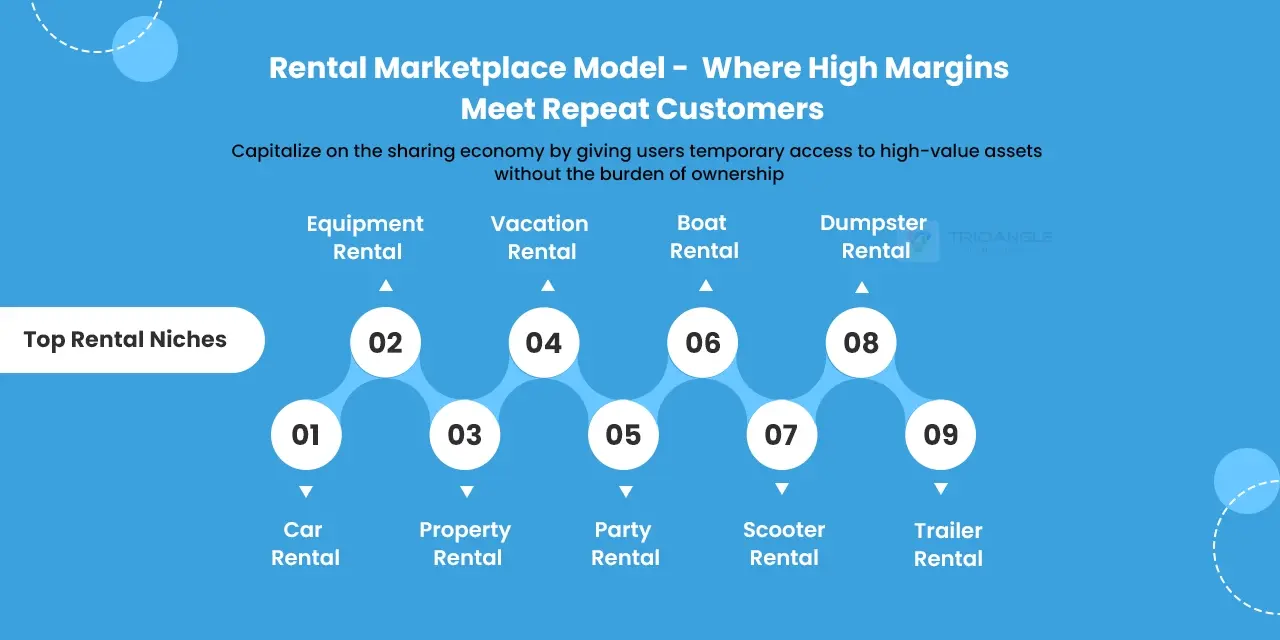
The most profitable rental niches to watch (and build) in 2026!
- Car Rental
- Equipment Rental
- Property Rental
- Vacation Rental
- Party Rental
- Boat Rental
- Scooter Rental
- Dumpster Rental
- Trailer Rental
#2. Services Marketplace Model – High Trust, Steady Leads
What is a Service Marketplace?
A service marketplace connects people who need work done with professionals who offer that service.
Unlike product marketplaces, the thing being sold here is time.
This makes service platforms slightly more complex than traditional ecommerce marketplaces.
When a customer buys a product, the transaction is simple. They choose the item, pay for it, and wait for delivery.
But when someone hires a service provider, coordination becomes part of the transaction.
| Service Marketplace | Aspects |
| Core Features | Scheduling calendars, service availability management, booking management, and in-app messaging. |
| Service Market scope | Ken Research reports the global service market at USD 2.1 trillion, driven by advances in AI, digital transformation, and operational efficiency. Freelance platforms market: Projected to reach USD 13.8B by 2030 at a CAGR of 16.1% Gig economy total: generates approximately USD 3.8T in annual global revenue (The Interview Guys Research Report, 2025) |
| Monetization | 1. Commission per booking: You can take a fee from the buyer, the seller, or both for each transaction. 2. Subscription plans for providers to access a defined number of listings. |
| Real-life examples of service marketplaces | Freelance: Upwork, Fiverr, Freelancer.com Home services: TaskRabbit, Handy, Thumbtack Pet care: Rover, Wag |
For founders, this marketplace model works well because it allows them to build a marketplace around skills rather than physical inventory.
The challenge is maintaining quality and reliability across the network of service providers.
From Zero to Service Marketplace in Minutes: Scheduling, availability matching, and booking flows are pre-built inside a marketplace website builder. Founders set their service categories, provider requirements, and commission rate. The platform takes it from there.
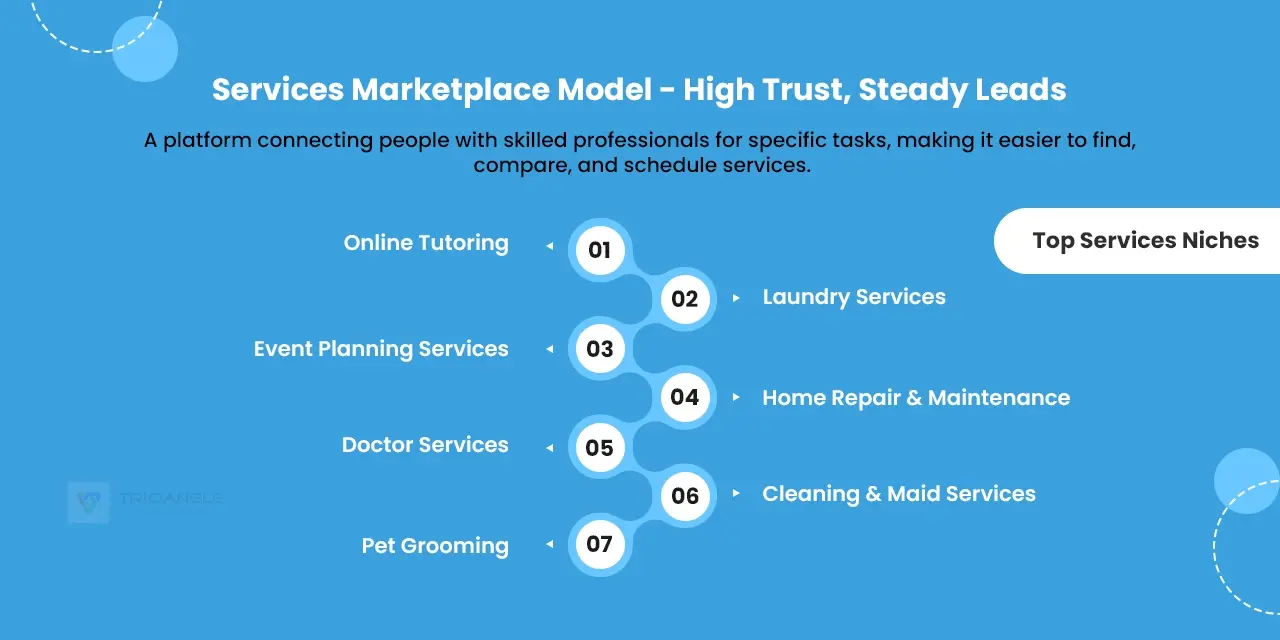
Profitable service opportunities for entrepreneurs in 2026
- Online Tutoring
- Laundry Services
- Event Planning Services
- Home Repair & Maintenance
- Doctor Services
- Cleaning & Maid Services
- Pet Grooming
#3. Selling Marketplace Model – High Volume, Big Impact
What is Selling Marketplace?
A selling marketplace allows multiple vendors to list and sell physical or digital products on a shared platform.
Most people refer to this model when they mention the word marketplace.
The platform has numerous independent sellers, as opposed to a single store selling its own products. The marketplace operator is the one who provides the infrastructure, and each vendor takes care of their listings.
To founders, the attraction is self-evident. The platform can be scaled without inventory.
Vendors bring the products. Buyers bring the demand. The platform generates revenue based on commissions or listing fees.
However, to operate this model, powerful marketplace management tools are needed; that’s precisely what you get with marketplace software.
| Selling Marketplace | Aspects |
| Core Features | Unified dashboards, product catalog management, tracking, commission calculation, and multi vendor payouts |
| Selling Market Scope | According to Next Move Strategy Consulting, the global Digital Marketplace Market is projected to reach USD 1,064.90 billion by 2030, driven by rising smartphone penetration and B2C dominance, and growing at a CAGR of 10.6%. Fashion & apparel (highest CAGR ~21%), Consumer electronics (~15%), Health & wellness |
| Monetization | 1. Commission per sale: percentage of each transaction. 2. Vendor subscription plans: a monthly fee for access to the platform and placing orders. |
| Real-life examples of selling marketplaces | General: Amazon Marketplace, Walmart Marketplace Fashion: AJIO, Vinted Electronics: Newegg, Best Buy Marketplace B2B: Alibaba Handmade/niche: Etsy |
Now, you might wonder how online marketplace software helps with that? It handles commission splits and payouts, lets you configure categories and fees, and streamlines onboarding. This helps you launch your platform quickly without worrying about every single feature or workflow.
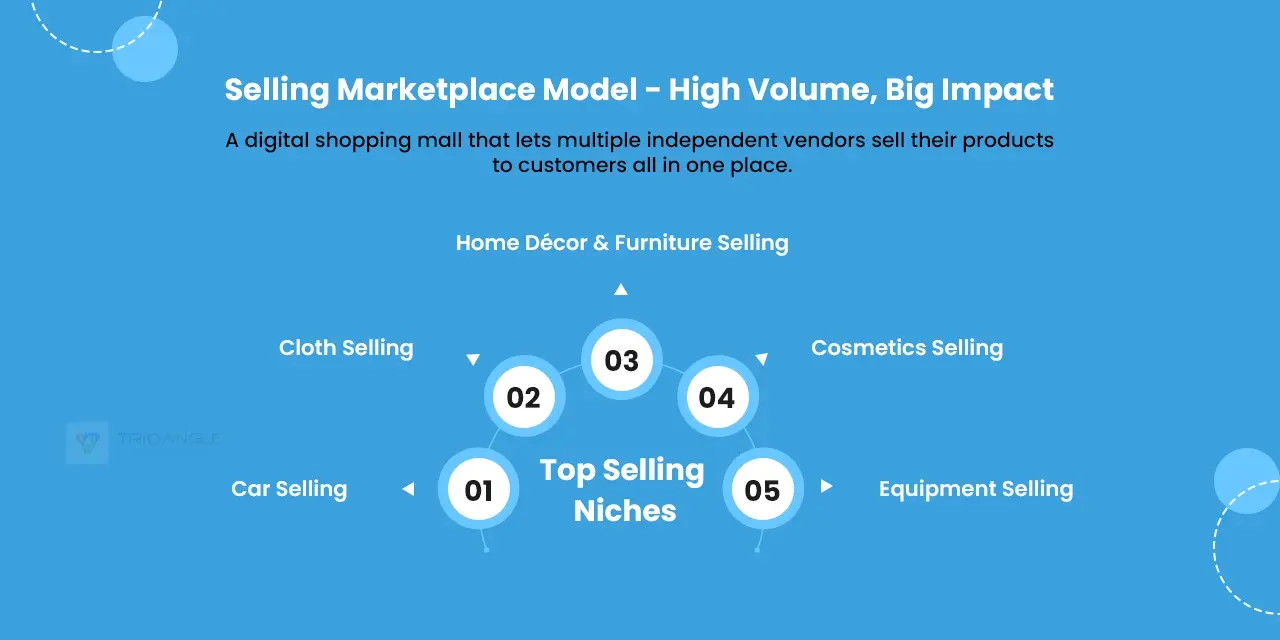
The most profitable selling niches to watch (and build) in 2026
- Car Selling
- Cloth Selling
- Home Décor & Furniture Selling
- Cosmetics Selling
- Equipment Selling
#4. Classifieds Marketplace Model: Low Barrier, Maximum Exposure
What is a Classified Marketplace?
A classified marketplace is a platform where users post listings and communicate directly to complete transactions, often outside the platform.
Imagine it as an online bulletin board.
Rather than the platform carrying out the whole transaction, it merely provides a linkage between people who wish to sell and buy.
Users place advertisements about products, services, or opportunities. Buyers interested in the product contact the seller and make the deal themselves.
But even a lightweight classifieds platform needs the right tools to manage listings, users, and trust at scale.
| Classified Marketplace | Aspects |
| Core Features | Listing creation & management, Smart search & filtering options, In-platform messaging, vendor subscription management, dispute resolution. |
| Classified Market Scope | According to ResearchAndMarkets, the online classified ad platform market is projected to reach USD 68.4B by 2030 at a CAGR of 9.1% |
| Monetization | 1. Ad posters pay to feature their ad at the top of category pages or search results 2. Listing packages for a defined number of posts, an extended listing period, or priority positioning. |
| Real-life examples of Classified marketplaces | General: Craigslist, OLX, Gumtree Automotive: Auto Trader, Cars.com, CarGurus Second-hand goods: Facebook Marketplace, OfferUp |
With SaaS marketplace software, you can just configure your listings and customize your branding and go live by clicking “launch”, while the technical aspects like handling servers and maintenance will be handled for you.
The most important problem is to establish trust and quality listings to ensure that the community keeps expanding.
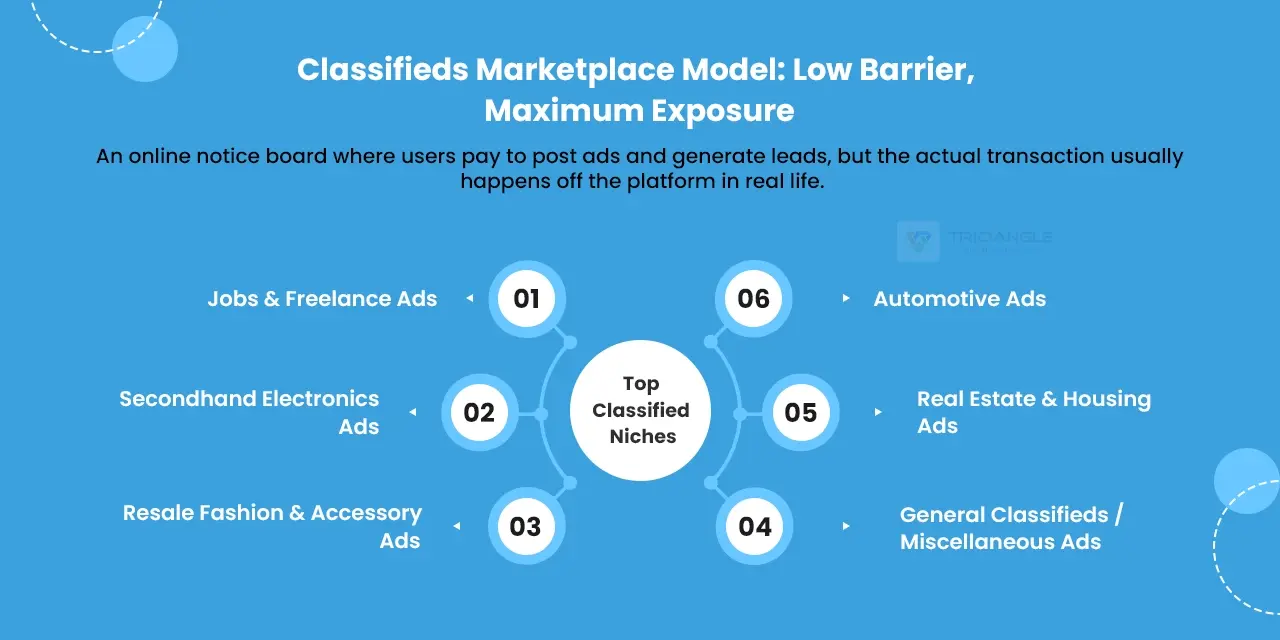
Profitable classified opportunities for entrepreneurs in 2026
- Jobs & Freelance Ads
- Secondhand Electronics Ads
- Resale Fashion & Accessory Ads
- General Classifieds / Miscellaneous Ads
- Real Estate & Housing Ads
- Automotive Ads
Frequently Asked Questions
Q1. What is a marketplace builder?
A marketplace builder is a SaaS platform that provides pre-built infrastructure for launching a multi-vendor online marketplace without writing code. Instead of building everything, founders can configure everything and go live without huge investments.
Q2. What is the chicken and egg problem in marketplaces?
The chicken and egg problem in marketplaces refers to the difficulty of attracting buyers without sellers, and sellers without buyers. New platforms face this by nature because neither side sees value in joining an empty network.
Q3. What are the four main types of online marketplace models?
The four core marketplace models are rental marketplaces, service marketplaces, selling marketplaces, and classified marketplaces. Most online marketplaces, regardless of niche, operate on one of these four transaction structures.
Q4. Why do marketplace builders say you can launch in minutes?
Most marketplace builders operate on a SaaS and cloud-based model, which means you don’t have to take time to build every feature or deal with server setup. The built-in features simplify the setup process, making way for a quicker launch.
Conclusion: What Should You Do After Choosing a Marketplace Model?
Once you choose a marketplace model, the next step is launching quickly and testing your idea with real users.
Many founders spend too much time planning the perfect platform.
But marketplace businesses rarely succeed because of perfect planning. They succeed because founders learn quickly from real market behavior.
This is why startups rely on online marketplace software. Explore a leading B2B SaaS platform today and try their free trial. Most trustworthy providers make one available.
Don’t wait any longer because, without traction, even the most beautiful platform will sit empty.
And that is the real lesson behind building marketplaces today.
Launch early, learn fast, and let the market guide what comes next.