What makes Hyperliquid the fastest-growing DEX in crypto history, and what does it take to build one? Here’s a number that should stop every fintech entrepreneur mid-scroll: $2.95 trillion in trading volume. One platform. One year. No venture capital behind it.
That’s Hyperliquid in 2025, a decentralized exchange that went from zero VC funding to Forbes’ Fintech 50 list in February 2026, pulled in $843 million in revenue, and captured 33% of the entire perpetual futures DEX market.
The HYPE token hit a market cap above $8.8 billion. TVL crossed $4.7 billion. Over 600,000 new users onboarded in a single fiscal year. And the founder, Jeff Yan, a former quantitative trader at Hudson River Trading, built it all with profits from his own trading firm. No dilution. No token unlocks for investors. Pure product-market fit.
So, how do you build something this powerful for your own brand? Let me tell you the exact steps to create a dex like Hyperliquid by partnering with an experienced DeFi Development Company.
Key Takeaways
Why Hyperliquid's model is the strongest blueprint for a perpetual futures DEX in 2026 🚀📊
The 7-step build process — from L1 architecture to launch🏗️⚙️
Revenue streams that turned a self-funded project into an $843M/year business💰📈F
eature-level breakdown with user, admin, and platform impact🧩👥
How to get a production-ready hyperliquid exchange built securely🔐🛠️
Why create a DEX like Hyperliquid
Every DEX before Hyperliquid made traders choose speed or decentralization. Fast execution meant centralized back-end infrastructure. On-chain transparency meant lag, slippage, and limited order types Hyperliquid refused that trade-off. And the market rewarded it.
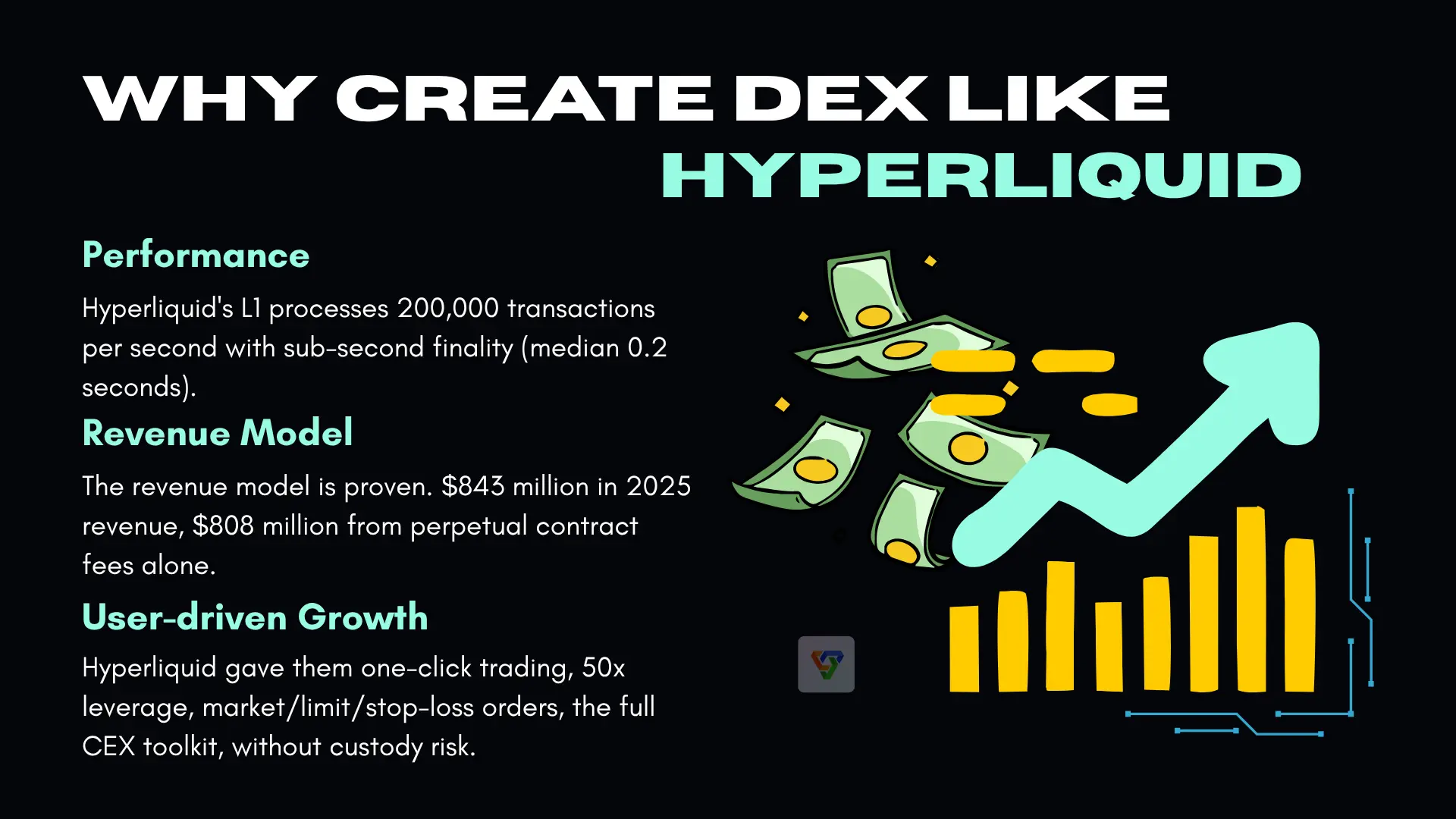
Performance
The performance gap is measurable. Hyperliquid’s L1 processes 200,000 transactions per second with sub-second finality (median 0.2 seconds). That’s not theoretical throughput. It’s production output processing $4 billion+ in daily perpetual futures volume. Compare that to most AMM-based DEXs that cap around 15-30 TPS and rely on liquidity pool mechanics that don’t suit professional-grade derivatives trading.
Revenue Model
The revenue model is proven. $843 million in 2025 revenue, $808 million from perpetual contract fees alone. Trading fees, liquidation spreads, and the Hyperliquid Assistance Fund (insurance pool) generate consistent, diversified income without relying on token inflation.
User-driven Growth
The user demand is real. Traders left centralized exchanges because of counterparty risk (FTX taught them that lesson permanently). But they won’t tolerate slow fills, limited order types, or clunky interfaces. Hyperliquid gave them one-click trading, 50x leverage, market/limit/stop-loss orders, the full CEX toolkit, without custody risk. For entrepreneurs, the opportunity is clear.
The global DEX segment recorded $4.49 billion in revenue in 2025 and is projected to reach $242 billion by 2033.
Building a hyperliquid exchange is entering a market with accelerating institutional demand and proven unit economics.
Let’s Discuss Your Requirements⚙️ Now
7 steps to create a DEX like Hyperliquid
Here are the 7 integral steps to create a Hyperliquid exchange with your business plans.
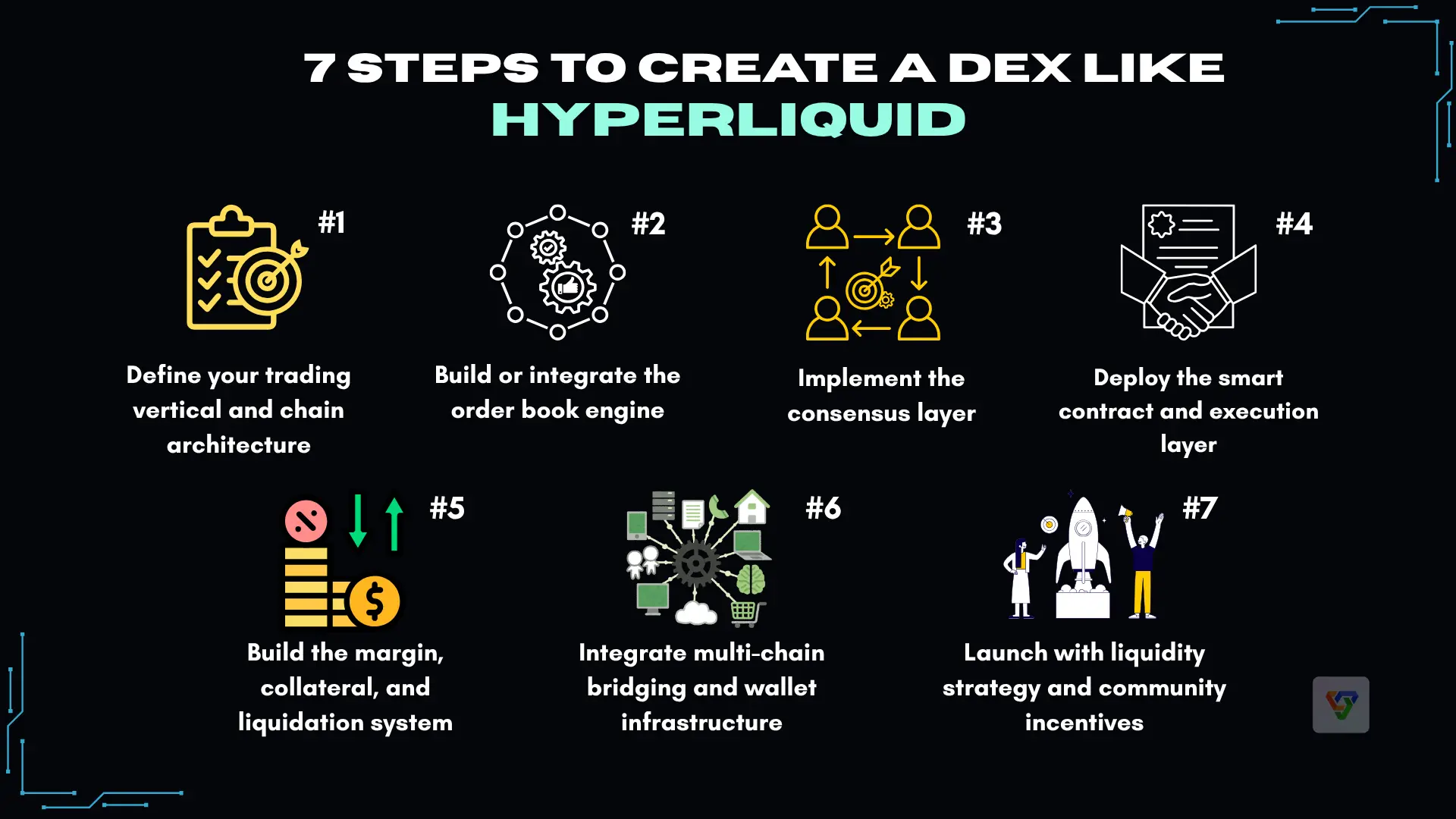
Step 1: Define your trading vertical and chain architecture
Decide whether you’re building for perpetual futures, spot, or both. Hyperliquid started with perps and added spot later, a smart sequencing move that concentrated liquidity. Choose between building a custom L1 (maximum control, higher cost) or deploying on an existing L2/L3 (faster to market, shared infrastructure).
Step 2: Build or integrate the order book engine
This is the backbone. Hyperliquid runs a fully on-chain Central Limit Order Book (CLOB), every order, cancellation, and fill is recorded on-chain. Your matching engine needs deterministic price-time priority, sub-second execution, and the capacity to handle a minimum of 20,000 operations per second at launch.
Step 3: Implement the consensus layer
Hyperliquid uses HyperBFT, a custom Byzantine Fault Tolerant consensus inspired by HotStuff. It combines PoS staking with BFT finality, achieving block times of 0.07 seconds. You need a consensus mechanism that tolerates up to one-third malicious validators while maintaining throughput above 100,000 TPS for institutional-grade reliability.
Step 4: Deploy the smart contract and execution layer
Structure a dual-environment architecture. HyperCore handles high-performance order matching, margin calculation, and liquidations. HyperEVM provides EVM-compatible smart contract execution for third-party dApps and governance. This separation is what lets Hyperliquid scale trading logic independently from general computation.
Step 5: Build the margin, collateral, and liquidation system
Implement cross-margin and isolated-margin modes. Define maintenance margin ratios, auto-deleveraging sequences, and insurance fund mechanics. Hyperliquid’s Assistance Fund absorbs liquidation losses before they socialize, a design that builds user trust because no trader gets unfairly liquidated to cover another’s position.
Step 6: Integrate multi-chain bridging and wallet infrastructure
Support USDC deposits from Arbitrum, Ethereum, Solana, and other major networks. Zero gas fees on trading (protocol absorbs L1 gas) with standard maker/taker fee structures. Self-custody wallets with no KYC, the combination that drives Hyperliquid’s user acquisition.
Step 7: Launch with liquidity strategy and community incentives
Hyperliquid’s genesis airdrop distributed 31% of HYPE supply (310 million tokens) to early users building loyalty before listing. Design your token distribution to reward genuine trading activity, not wash trading. Points-based campaigns and seasonal incentive structures help bootstrap liquidity without diluting long-term holders.
Benefits of creating a Hyperliquid app
An app becomes a mandatory part of all niches as it gives users the ability to access your platform anytime and anywhere.
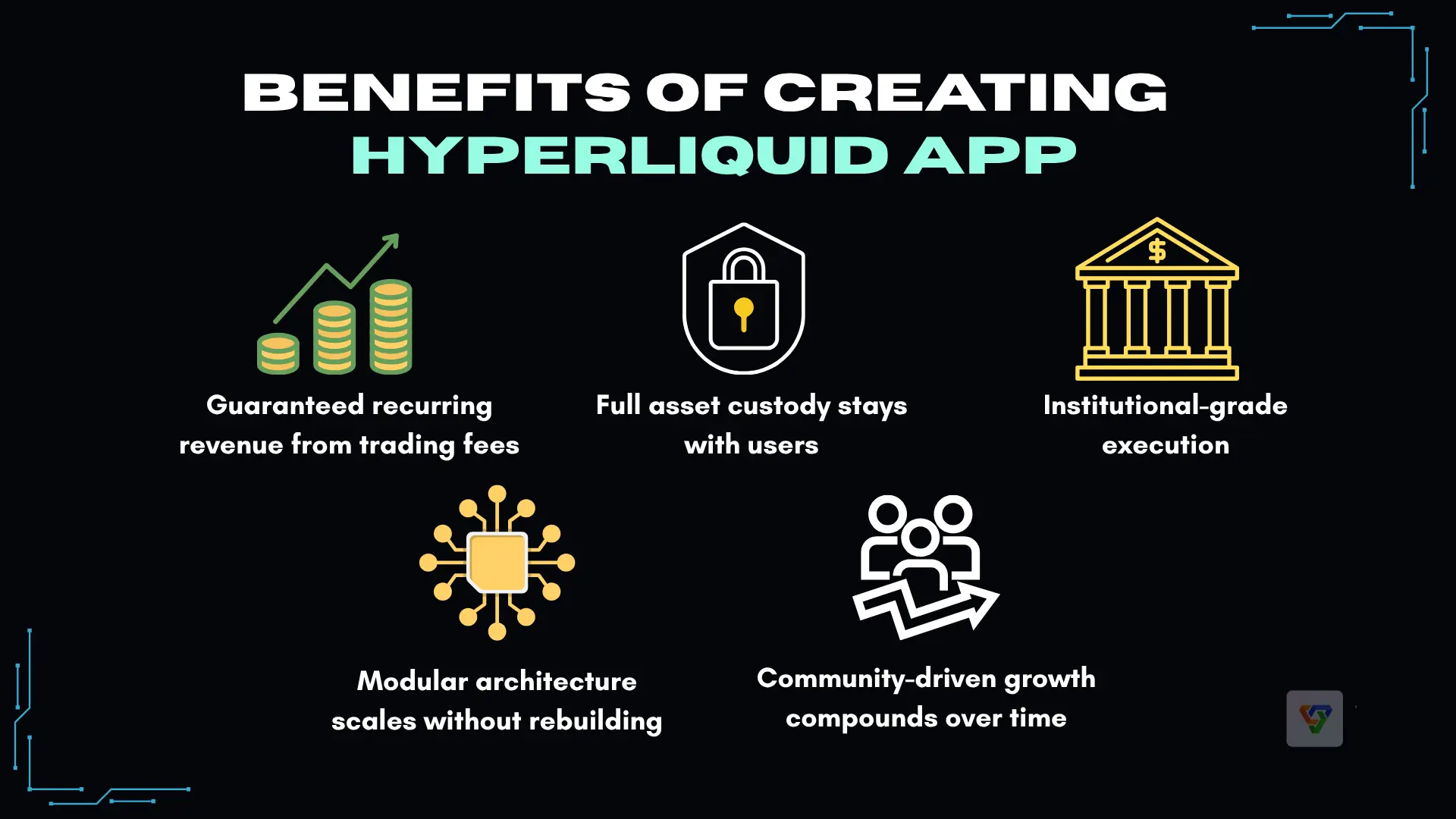
Guaranteed recurring revenue from trading fees
Every trade executed on your platform generates maker and taker fees. Hyperliquid earned $808 million from perp fees alone in 2025. With 50x leverage available, even modest daily volumes produce meaningful fee income. Liquidation spreads, and insurance fund premiums add secondary revenue layers that activate automatically during volatile markets.
Full asset custody stays with users
Self-custody architecture means you never hold user funds directly. That eliminates the regulatory burden of custodial licensing in most jurisdictions. It reduces your operational liability. And post-FTX, it’s the single most powerful trust signal you can give traders. Users keep their keys. You keep their loyalty.
Institutional-grade execution
It attracts high-value traders with 200,000 TPS. Sub-second finality. On-chain order book with full transparency. It’s built for market makers, prop desks, and algorithmic traders who move serious volume. One institutional market maker can generate more daily fees than thousands of retail users. Building for that tier from day one shapes API latency, order types, and co-location options.
Modular architecture scales without rebuilding
The dual-environment design (core trading engine + EVM-compatible smart contract layer) means you can add spot markets, options, prediction markets, or lending products without touching the matching engine. Each new vertical plugs into existing infrastructure. That’s how Hyperliquid expanded from perps-only to a full financial ecosystem within 18 months.
Community-driven growth compounds over time
Hyperliquid’s no-VC model proved something. when 76.2% of the token supply goes to the community, the community markets the product for you. Token holder incentives, governance participation, and airdrop campaigns create organic demand loops that paid advertising can’t replicate.
Launch your own Hyperliquid App & Start Earning
Why Trioangle for a secure Hyperliquid exchange development
Building a DEX like Hyperliquid requires more than smart contract templates pulled from open-source repositories. It demands production-grade infrastructure order-book engines tested under volatility, liquidation systems that don’t fail during flash crashes, and consensus mechanisms validated at 100,000+ TPS. Trioangle brings that production-grade development to the table.
The team has delivered custom DEX platforms, perpetual futures engines, and multi-chain wallet integrations. With deep DeFi expertise for startups and enterprises across 15+ countries.
Every build includes end-to-end security audits, cross-margin/isolated-margin architecture, and admin dashboards that give operators full control over fee structures, leverage tiers, listing policies, and liquidity incentive programs. What you get is a hyperliquid exchange engineered to your specifications, your branding, your fee model, your token economics, and your market. Battle-tested. Compliance-ready. Scalable from launch-day volume to institutional-grade throughput.
The decentralized trading market is worth $4.49 billion today. It’s projected at $242 billion by 2033.
Start Building Your Hyperliquid Exchange and build a Billion-Dollar Market with trust and credibility.
FAQs
Hyperliquid is a self-funded decentralized exchange built on its own Layer 1 blockchain. It processed $2.95 trillion in trading volume in 2025, generated $843 million in revenue, and made Forbes’ Fintech 50 list in 2026, all without venture capital. For entrepreneurs, it proves that a well-architected DEX with on-chain order book trading can compete directly with centralized exchanges on speed, execution quality, and revenue generation.
Cost depends on the scope. A perpetual futures DEX with custom L1 architecture, on-chain CLOB, multi-chain bridging, and production-grade security audits typically ranges from $80,000 to $350,000+, depending on feature depth, chain customization, and compliance requirements. Deploying on an existing L2 reduces infrastructure costs but trades off some performance control.
Primary revenue comes from maker/taker trading fees on every executed order. Secondary streams include liquidation spreads (profit from auto-closing underwater positions), insurance fund premiums, and token listing fees. Hyperliquid earned $808 million from perpetual contract fees alone in 2025, proving that fee-based revenue at scale surpasses most token-dependent models.
Hyperliquid operates on its own custom Layer 1 blockchain using HyperBFT consensus (a PoS + BFT hybrid inspired by HotStuff). It supports 200,000 TPS with 0.2-second median finality. The architecture separates trading execution (HyperCore) from EVM-compatible smart contracts (HyperEVM), letting the platform scale each independently.
Yes. You can deploy on existing high-performance L2s or L3s (Arbitrum, Base, or app-specific rollups) and still achieve competitive execution speeds. The trade-off is less control over consensus-level optimization, but you gain faster time-to-market and lower infrastructure costs. The order book, margin system, and smart contract logic remain custom regardless of the base chain.
Sources: Forbes Fintech 50 (Feb 2026), DeFiLlama, KuCoin Research, Artemis Analytics, CoinMarketCap, Statista DEX Revenue Report 2025, Binance Research, CoinGecko.
Disclaimer: The Logo of the Hyperliquid is used for demonstration purposes only.