
Are you thinking about launching a cryptocurrency business? Although the potential is thrilling, many entrepreneurs fail to consider the regulatory challenges faced by cryptocurrency businesses. For any successful cryptocurrency business, navigating regulations, obtaining the appropriate license, and staying abreast of regulatory changes are essential.
Meeting compliance needs should be a top priority because these issues can impact their cryptocurrency exchange script from day-to-day operations to investor trust. Understanding the legal environment enables business owners to safeguard their concepts, cut expenses, and expand more successfully. The most frequent regulatory issues that crypto startups regulatory challenges encounter will be discussed in this blog, along with license and compliance requirements and workable solutions.
What is crypto regulation in 2026?
In 2026, the term “crypto regulation” refers to the expanding body of laws, policies, and procedures that governments and financial organizations are util
izing to regulate cryptocurrencies, blockchain initiatives, and crypto businesses. Regulators are focusing on investor protection, know-your-customer (KYC) compliance, preventing money laundering (AML), tax management, and crypto exchange security as digital assets become more and more popular worldwide.
By 2026, several nations will have standardized crypto licensing guidelines, made it clear which coins fall under the securities category, and tightened regulations on trading platform compliance. For startups, following these standards is essential for operating legally, attracting investors, avoiding fines, and building user trust.
Common Crypto Startups Regulatory Challenges
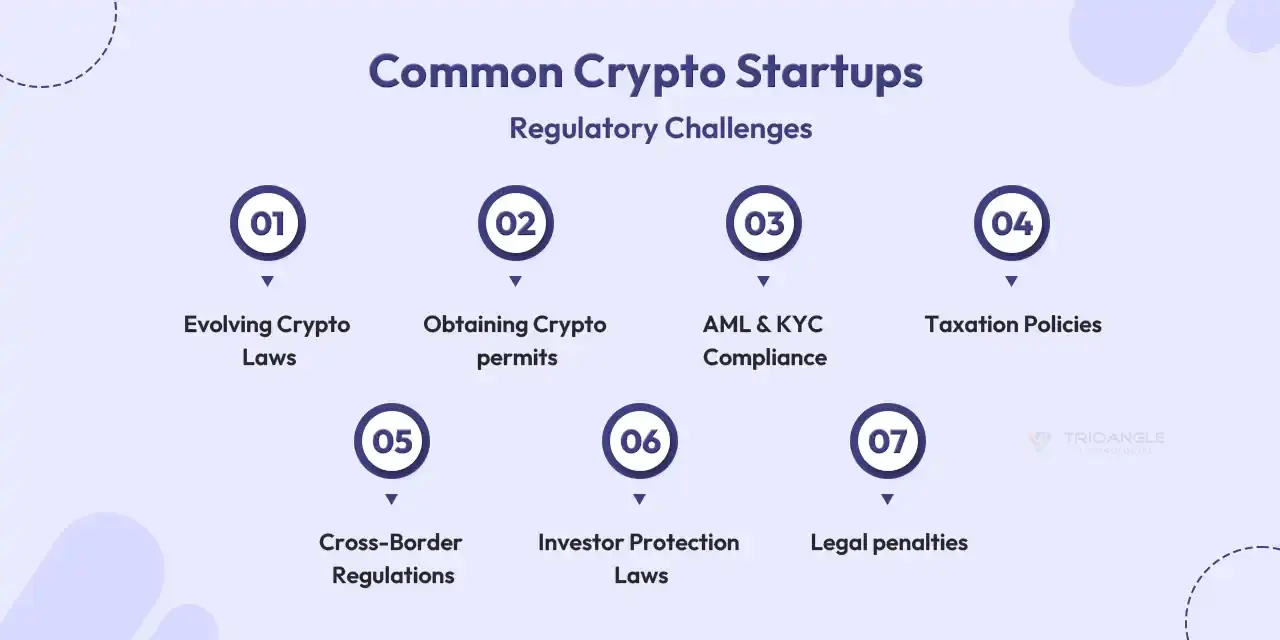
Evolving the Crypto Laws
It is challenging for businesses to stay legal because regulations differ by area and are always changing.
Getting Permits for Crypto
Obtaining the necessary permits can be expensive, time-consuming, and complex.
Compliance with AML and KYC
Avoiding fines requires adherence to the Know Your Customer and Anti-Money Laundering laws.
Policies Regarding Taxation
For new crypto businesses, understanding tax rules is a major challenge, especially when comparing them to tax-free crypto countries.
Regulations Across Borders
Navigating different legal frameworks and limitations is necessary when working internationally.
Laws Protecting Investors
Providing stakeholders with legal protection makes compliance even more challenging.
Penalties under the law
Fines, business restrictions, or closures could follow noncompliance with any regulations.
Importance of the crypto license for startups
- Any new blockchain business that wishes to establish credibility and trust in the world of digital finance must first obtain a cryptocurrency license.
- Many cryptocurrency startups regulatory challenges as a result of different international regulations and ambiguous licensing requirements.
- A strong cryptocurrency license enhances investor trust, banking relationships, and market expansion while validating your company.
- Additionally, it assists new businesses in avoiding fines, closures, and compliance issues that frequently result from operating unregulated.
Crypto Licensing Process: Steps to Compliance
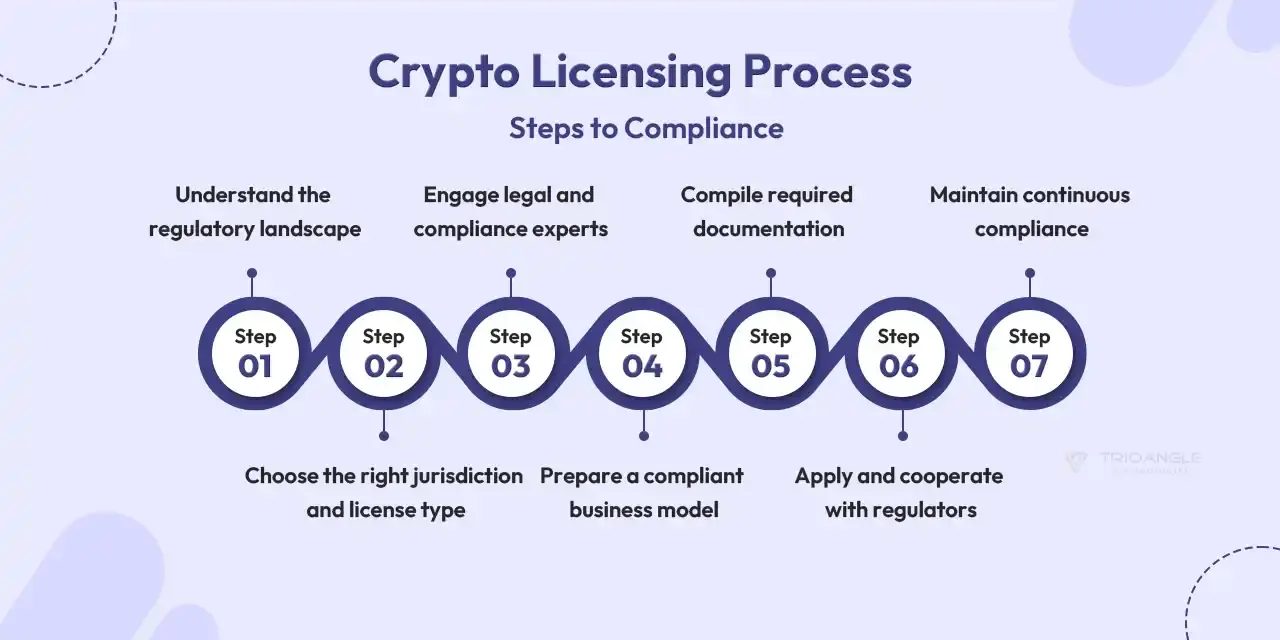
Step 1: Understand the regulatory landscape
To identify prospective Crypto Startups Regulatory Challenges, research local and worldwide crypto legislation, as well as recent crypto regulation revisions, such as the Korean crypto regulation.
Step 2: Choose the right jurisdiction and license type
Determine whatever type of license your startup needs for trading, custody, or payments, and then choose a jurisdiction that is compatible with your business objectives.
Step 3: Engage legal and compliance experts
Hire skilled advisors to assist you in navigating licensing requirements and mitigating regulatory concerns.
Step 4: Prepare a compliant business model
To comply with regulatory requirements, integrate KYC/AML rules, security of data, and consumer security measures into your Guaranteed business model.
Step 5: Compile required documentation
Gather the business strategy, AML/KYC regulations, proof of funding, technical structure, and organizational data required for the application.
Step 6: Apply and cooperate with regulators
To effectively face Crypto Startups Regulatory Challenges, file your licensing application precisely, respond to all the questions quickly, and maintain transparency.
Step 7: Maintain continuous compliance
Conduct regular audits, update rules to reflect new cryptocurrency legislation, and guarantee your operations stay completely compliant after approval.
How Regulatory Updates Impact Your Crypto Business Ideas
- Changes to regulations have a significant impact on how crypto businesses develop and expand their business plans.
- Constant revisions to cryptocurrency regulations may affect compliance standards, trading licenses, and tax liabilities.
- Many regulatory hurdles for crypto startups occur when regulations differ across countries.
- Before launching, startups must conduct research on the crypto licensing process in each market.
- Delays in adapting to new standards can impede product launches and investor funding.
- Understanding cryptocurrency rules early on helps entrepreneurs create compliant business strategies.
- Monitoring worldwide legislation guarantees that your cryptocurrency company ideas remain future-proof.
- Staying up to date on legal developments can help crypto startups regulatory challenges more effectively.
What are the strategies to overcome these regulatory challenges?
Examine regional and international laws
To prevent unforeseen regulatory problems, every cryptocurrency company should study the laws of each target region before launching.
Acquire the appropriate crypto licenses
To operate lawfully and win over users, get the required cryptocurrency license or registration.
Employ compliance and legal
Experts can help you navigate the complex regulatory challenges faced by crypto startups and make sure your business conforms with all applicable laws.
Robust KYC/AML verification
A respectable and open exchange environment is facilitated by adhering to these global compliance standards.
Keep up with updates on crypto regulations
A company can stay ahead of new developments by routinely reviewing government and financial regulatory statements.
Make use of the blockchain auditing tool
Legal risks are eliminated and reporting is made simpler with automated compliance and monitoring tools.
Create the platform with compliance
Collaborating with authorized exchanges or payment processors may help your company gain a reputation.
Educate your team on regulations
Training employees about cryptocurrency rules and compliance culture enables your company to operate ethically and avoid penalties.
Future trends in crypto regulations
- It is anticipated that future regulations for crypto startups will be more structured and stringent.
- Governments are enforcing stronger anti-money laundering regulations, tougher investor protections, and higher compliance standards.
- Entrepreneurs will need to adapt to different legal environments, but global regulatory cooperation will close gaps.
- Regulations about taxes, custody, and trading will be impacted by new licensing laws and the expansion of digital asset classifications.
- Crypto businesses can overcome obstacles and prosper in this changing environment if they implement compliance technology early and stay abreast of regulatory changes.
Conclusion
In conclusion, it can seem difficult to navigate the crypto startups regulatory challenges, but by staying informed and acting, compliance can be used as a competitive advantage. By acquiring the required crypto licenses, adhering to current regulations, and putting a sound plan into place, startups can function safely, establish credibility, and expand successfully. Long-term success in the changing cryptocurrency ecosystem depends on overcoming these obstacles.